

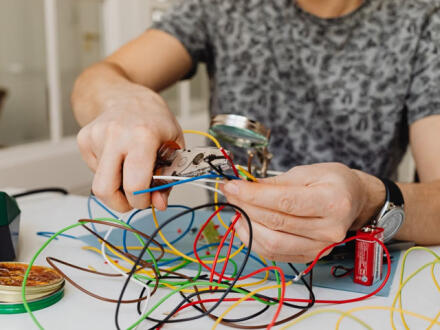
Students who want a hands-on career in motor controls, industrial maintenance, or automated equipment often run into the same problem fast: tools, tuition, books, and lab fees add up. In California, community college enrollment fees alone are typically $46 per unit, and a full-time student can still spend hundreds more on multimeters, safety gear, boots, and transportation.
That's why California Electrical Motor Systems Technician Scholarships matter so much. They can cut the cost of training, reduce work hours during school, and help students stay focused on certifications, labs, and internships instead of scrambling for every dollar.
This guide breaks down 6 practical scholarship and funding paths for students aiming at an electrical motor systems technician path. It covers options for high school seniors, community college students, university students, and first-year applicants. It also points to industry and association awards that connect directly to electrical, HVAC, industrial maintenance, and engineering technology careers.
The goal is simple: help students find money that actually fits this career path. Some awards are broad. Others are tied to electrical associations, construction groups, or engineering organizations. But all of them can support the same end result: getting trained for real motor systems work without taking on more debt than necessary.
1. California Community College Career Education Scholarships For Electrical Motor Systems Technician Students
California community colleges are often the most direct starting point for this field. Many students train through programs in industrial maintenance, electrical technology, mechatronics, automation, or HVAC controls, then move into technician roles with manufacturers, utilities, water districts, or contractors.
That matters because community colleges tend to stack funding. A student might combine a campus scholarship, a department award, a fee waiver, and emergency aid. Even a modest package of $500, $1,000, and $1,500 awards can cover books, tools, and several units of tuition.
A smart first move is checking career education offices, financial aid pages, and scholarship databases together. Students using large scholarship directories often sort faster by trade, major, and state, and broad scholarship filters can help surface awards that don't show up on one campus page alone.
Community college students should also look beyond programs with the exact words "motor systems" in the title. Related majors often qualify, including:
- Electrical technology
- Mechatronics
- Industrial maintenance technology
- Electromechanical technology
- HVAC/R
- Automation and controls
A student in a two-year program who takes 12 units per term could finish core coursework in about 4 semesters. That short timeline makes scholarship timing important. Missing one deadline can mean losing funding for an entire term.
Who Qualifies And How Community College Awards Usually Work
Eligibility usually starts with basics: California residency or local enrollment, a declared certificate or degree path, and a minimum GPA. Many schools set that floor at 2.5 or 3.0, though career education grants can be looser when the student shows strong attendance and instructor support.
Community college awards usually fall into three buckets:
- General campus scholarships for all majors
- Career education awards for trade and technical students
- Foundation or donor awards tied to local employers
The strongest applications often include concrete proof that the student is serious about this field. That can mean:
- Completion of an intro circuits or motor controls class
- OSHA safety training
- A letter from an instructor who watched the student wire a control panel correctly
- Part-time work in maintenance, warehouse automation, or construction
For students in related construction pathways, the Future Contractors of California Scholarship fits well when their training overlaps with electrical systems, jobsite safety, and contractor-facing work.
A practical example helps. A student in Fresno taking 15 units in industrial maintenance might spend roughly $690 in enrollment fees before books and gear. Add $180 for textbooks, $120 for PPE, and $95 for hand tools, and one small scholarship suddenly matters a lot.
2. Skilled Trades Scholarships For California High School Students Planning An Electrical Motor Systems Technician Path
High school students often assume scholarships only reward future nurses, teachers, or four-year engineering majors. That's a mistake. There are real California Electrical Motor Systems Technician Scholarships for High School Students, especially for seniors planning trade school, community college, or applied technology programs.
The strongest candidates usually show direction early. A student who took shop, robotics, engineering, agricultural mechanics, or physics already has a story to tell. So does a student who spent 200 hours helping a family member repair pumps, gates, or irrigation motors.
Trade-focused scholarships also like evidence of reliability. Attendance, work history, CTE participation, and dual enrollment can matter as much as test scores. For students still in high school, awards tied to utility, cooperative, or technical career tracks can be especially useful, such as the Electrify Your Future Scholarship or the Tanner Electric Cooperative High School Scholarships.
Students should think in layers, not one perfect application. A senior might apply to:
- One local education foundation scholarship
- Two skilled trades awards
- One utility-related award
- One broad workforce scholarship
- One college-specific scholarship after admission
Submitting 6 well-matched applications is often smarter than sending 20 generic ones.
How To Find California Electrical Motor Systems Technician Scholarships For High School Students
The search works best when students use the exact training words colleges and donors use. "Electrical motor systems technician" may be too narrow by itself. Broader terms bring up more results.
Useful search terms include:
- Electrical technology scholarship California
- Industrial maintenance scholarship California
- Mechatronics scholarship California
- Skilled trades scholarship for high school seniors
- HVAC electrical scholarship California
They should also ask three people at school, not just Google:
- The CTE coordinator
- The school counselor
- The teacher who runs robotics, shop, or engineering classes
Those staff members often know about local awards worth $500 to $2,500 that never get much online attention.
A good application essay uses specifics. Instead of saying, "They like working with electricity," a stronger line is, "They rebuilt a 3/4-horsepower garage door motor with a mentor, traced a failed capacitor, and watched the system run again." That sounds real because it is real.
Students who plan to enter electrical, HVAC, or mechanical systems can also look at adjacent industry awards like the Air Systems Foundation Scholarship, especially when their future coursework includes motors, controls, and building systems.
3. College-Based Awards For Electrical, Industrial Maintenance, And Mechatronics Majors In California
For enrolled students, college-based awards are often the easiest money to miss. That sounds backward, but it happens all the time. Students fill out federal aid forms, then ignore department emails with scholarships worth $750, $1,200, or $3,000.
This category matters for students seeking California Electrical Motor Systems Technician Scholarships for College because many campus awards don't require the exact major name. A student in electrical technology, electronics, industrial systems, or mechatronics may still qualify if the coursework supports motor diagnostics, controls, drives, and maintenance.
College-based awards usually come from:
- Department funds
- College foundations
- Alumni donors
- Industry advisory boards
- Regional employers that hire from the program
Applied programs often have solid labor-market logic behind them. The U.S. Bureau of Labor Statistics reports median pay of $64,560 for industrial machinery mechanics and $72,800 for electrical and electronic engineering technologists and technicians. Those numbers help scholarship committees see that technical training leads to stable work, not just classroom theory.
Students in engineering-adjacent pathways may also qualify for broader technical awards, including the Southern California Member Chapter Scholarship when their program connects with systems, equipment, or applied design work.
Best Options For California Electrical Motor Systems Technician Scholarships For College
The best options usually sit in the overlap between major, location, and career outcome. Students should start with the campus foundation portal, then check the department chair, faculty advisor, and workforce development office.
Strong-fit scholarship categories include:
- Electrical and electronics program awards
- Industrial technology department scholarships
- Career technical education retention grants
- Employer-sponsored technician awards
- Transfer-pathway scholarships for students moving into applied engineering programs
A student stands out more when the application shows measurable progress. Good examples include:
- Completed 3 lab courses with grades of B or higher
- Worked 18 hours per week in equipment maintenance
- Logged 40 volunteer hours supporting a robotics team
- Earned an instructor endorsement for troubleshooting motor starters
One practical strategy is to build a one-page "evidence sheet." It lists GPA, courses, tools used, work history, certifications, and target job titles. That sheet makes future applications much faster. On platforms that simplify matching, students can often reuse core details and cut the application process to a couple of minutes for basic awards instead of rewriting the same facts over and over.
4. University Scholarships Linked To Engineering Technology And Applied Electrical Systems
Not every future motor systems technician stays in a two-year lane. Some students move into bachelor's programs in engineering technology, electrical engineering technology, industrial technology, manufacturing systems, or applied automation. That opens another pool of California Electrical Motor Systems Technician Scholarships for University applicants.
These scholarships often reward students who can connect hands-on experience with higher-level study. A transfer student who has already wired control circuits or maintained VFD-driven equipment brings something valuable to a university application. They aren't just learning theory: they've seen a machine fail at 6:40 a.m. and know what downtime costs.
University-based funding also tends to be larger. While some departmental awards are $1,000 to $2,500, engineering and foundation scholarships can be much higher, especially when donors want to support workforce pipelines in power, manufacturing, and infrastructure.
Students looking at applied engineering routes may find relevant fits in broader technical programs such as the ACEC California Scholarship, particularly when their long-term goal includes design support, field engineering, or complex electrical systems work.
Where To Look For California Electrical Motor Systems Technician Scholarships For University
Students should search in four places first. That keeps the process focused and prevents deadline overload.
- College of engineering or technology scholarship pages
These often list awards by department, transfer status, or academic interest.
- University foundation databases
Many have one common application that matches students to 10 or more awards at once.
- Industry-sponsored scholarships
Manufacturers, utilities, and engineering groups often support students in power, controls, and systems fields.
- Transfer center resources
Students coming from community college sometimes miss transfer-only awards that can cover a big chunk of tuition.
The essay should explain the bridge between coursework and work. For example: a student learned ladder logic in class, then used that knowledge to diagnose a conveyor shutdown caused by a faulty overload relay. That kind of detail is far more persuasive than generic passion statements.
Students from underrepresented backgrounds should also review identity-based and utility-related awards when eligible, including the Southern California Edison Scholarship. The key is fit. A well-matched application beats a broad one almost every time.
5. First-Year Student Scholarships That Help Cover Tools, Tuition, And Training Costs
First-year students face a weird cost pattern. Tuition gets most of the attention, but startup expenses hit hard in the first semester. A student may need steel-toe boots for $85, safety glasses for $14, a meter for $60 to $140, notebooks, software access, and transport to labs or shop classes.
That makes California Electrical Motor Systems Technician Scholarships for first-year students especially useful. These awards often cover the exact costs that push students off track in the first few months.
Good first-year funding sources include:
- College welcome scholarships
- Career education book grants
- Workforce training stipends
- Local community foundation awards
- Trade and industry scholarships open to entering students
Students should apply even if the amount looks small. A $750 scholarship can pay for a meter, PPE, and course materials. That may be the difference between attending every lab ready to work or borrowing gear each week.
Broader electrical industry programs can fit here too. For example, the Alltricity Scholarship Foundation Scholarship may appeal to students entering energy or electrical pathways, even if their long-term role is more technician-focused than utility-office focused.
How First-Year Applicants Can Stand Out In Competitive Scholarship Pools
First-year applicants often lose points because they sound vague. They haven't built a long college record yet, so the application has to prove potential with specifics.
The strongest applications usually include these pieces:
- A clear program plan: certificate, associate degree, or transfer route
- A precise career target: motor systems technician, maintenance technician, controls technician, field service technician
- Real examples: shop class projects, paid work, family repair jobs, or robotics builds
- A budget snapshot: exact numbers for tuition, books, tools, and commuting
A useful mini-budget might look like this:
- Enrollment fees: $552 for 12 units
- Books and access codes: $210
- PPE and boots: $125
- Basic tool kit: $180
- Fuel or transit for lab attendance: $64 per month
That level of detail helps a reviewer picture the student's situation. It also shows maturity.
Another smart move is applying early. Some funds are first-come, first-reviewed, or simply stronger before the deadline rush. Students who submit 3 to 4 weeks ahead usually have more time to fix missing transcripts, signatures, or recommendation letters.
6. Association, Union, And Industry-Partner Scholarships Connected To Motor Systems Careers
Some of the best funding doesn't come from a school at all. It comes from the groups closest to the work: trade associations, labor organizations, cooperatives, contractors, and manufacturers. For students chasing motor systems work, these programs can be a strong fit because they understand the actual job.
That's where California Electrical Motor Systems Technician Association Scholarships and similar programs become valuable. Even when an award is not labeled for motor systems alone, it may still support students in electrical trades, power systems, industrial maintenance, or building systems technology.
Industry-linked scholarships often reward:
- Career commitment
- Trade-related coursework
- Community involvement
- Employer recommendations
- Interest in shortage areas such as power, controls, and maintenance
They also offer networking value. A $1,500 award attached to an association banquet, chapter meeting, or employer panel can lead to internships, mentors, or a first interview.
Examples that align with electrical and engineering-related paths include the Mountain View Electrical Association Scholarships and the National Electrical Manufacturers Association Educational Scholarships. Even when location or major rules vary, they show the kind of industry-connected funding students should hunt for.
California Electrical Motor Systems Technician Association Scholarships And Similar Industry Programs
Students should look for associations in five buckets. That keeps the search practical.
- Electrical contractor groups
- Engineering associations
- HVAC and mechanical associations
- Utility and power organizations
- Local union or apprenticeship support foundations
A strong association application explains how the student fits the trade pipeline. For example, they may want to maintain pump motors in water facilities, troubleshoot packaging lines in food manufacturing, or service drive systems in commercial buildings.
Numbers help here too. California's economy includes massive demand from logistics, agriculture, water infrastructure, semiconductor support, and commercial building operations. A single distribution center can run dozens of conveyors and motors across one shift, and every hour of downtime costs real money.
Students should also ask whether the scholarship comes with extras:
- Paid internship interviews
- Tool stipends
- Conference access
- Mentor matching
- Resume review by employers
Those extras can be worth more than the check itself. A student who leaves an association event with 2 business cards, one referral, and one internship lead is already ahead of many applicants.
California Electrical Motor Systems Technician Scholarships FAQs
What types of scholarships are available for California community college students studying electrical motor systems?
California community college students can access various scholarships including general campus awards, career education grants for technical fields, and foundation scholarships from local employers. These help cover tuition, tools, books, and fees to ease financial burdens during training.
How can high school students in California find scholarships related to becoming electrical motor systems technicians?
High school students should search for scholarships using broader terms like electrical technology or industrial maintenance. They can consult their CTE coordinators, counselors, or robotics teachers for local awards such as the Electrify Your Future Scholarship and Tanner Electric Cooperative High School Scholarships.
What are important tips for first-year students applying for electrical motor systems technician scholarships in California?
First-year students should apply early and include specifics in applications, such as exact program plans, detailed career goals, and cost breakdowns for tuition, tools, and PPE. Scholarships like the Alltricity Scholarship Foundation Scholarship can help with startup expenses like safety gear and meters.
Are there scholarships linked to electrical trade associations for motor systems technician students in California?
Yes, trade associations provide scholarships that reward career commitment and trade coursework. Examples include the Mountain View Electrical Association Scholarships and the National Electrical Manufacturers Association Educational Scholarships, which may offer networking and internship opportunities.
Can students pursuing electrical motor systems technician careers at universities find relevant scholarships in California?
University students aiming for engineering technology or applied electrical systems can access larger scholarships through engineering departments, university foundations, and industry sponsors. Programs like the ACEC California Scholarship support students connecting hands-on experience with higher education goals.







