Choosing a college major before medical school can feel like selecting the first piece of a very long puzzle. You may assume that a dedicated pre-medicine major is the most direct route to becoming a physician. In practice, it can be a useful, structured option, but it isn't automatically better than biology, chemistry, psychology, or another field you genuinely enjoy.
The important distinction is that pre-medicine is often an advising track or concentration rather than a standardized academic major. Requirements vary substantially by college. Some schools offer a formal "pre-medical studies" degree, while others simply let you complete medical-school prerequisites alongside any major.
This review evaluates the pre-medicine college major for prospective medical students. You'll learn what you typically study, how the workload compares with other majors, what jobs are available before medical school, how much you might earn, and whether the degree offers a strong return on your educational investment. The short version: pre-medicine can be worthwhile if you value structure and advising, but your academic performance, experiences, and readiness for the MCAT matter more than the label on your diploma.
Pre-Medicine Major At A Glance
A pre-medicine program is designed to prepare you for medical-school prerequisites, the Medical College Admission Test (MCAT), clinical exposure, and the application process. It usually combines foundational science courses with advising, ethics, communication, research, and opportunities to volunteer or shadow healthcare professionals.
But, pre-med is not generally a professional degree that qualifies you to practice medicine. You still need to complete medical school, residency training, and licensing requirements. At many universities, "pre-med" is a pathway attached to another major rather than a standalone major.
| Factor | What to expect |
|---|---|
| Primary purpose | Preparation for medical-school admission and healthcare careers |
| Typical length | Four-year bachelor's degree, followed by medical school |
| Common coursework | Biology, general and organic chemistry, physics, biochemistry, statistics, and writing |
| Major advantage | A clear sequence of prerequisites and specialized advising |
| Main limitation | Less flexibility at some schools and no guaranteed medical-school admission |
| Best fit | Students who want structured preparation and are comfortable with intensive science |
Your school's program title matters less than its actual curriculum. Before enrolling, check whether it includes the prerequisite courses required by your target medical schools, supports MCAT preparation, and provides meaningful clinical and research opportunities.
What Courses And Skills Does Pre-Medicine Include?
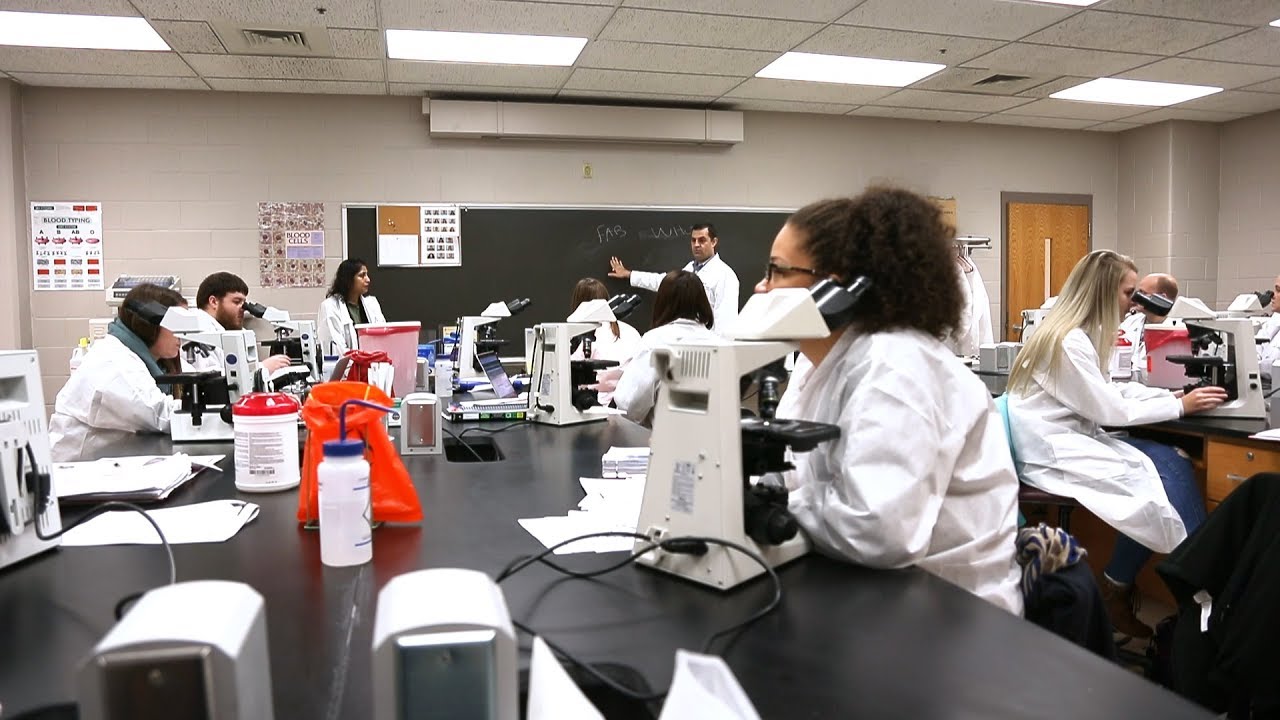
Most pre-medicine curricula include the science foundation expected by medical schools. Common requirements include two semesters each of general biology, general chemistry, organic chemistry, and physics, usually with laboratory components. Biochemistry, psychology, sociology, mathematics, statistics, and college writing are also frequently recommended or required.
Some programs add courses such as genetics, anatomy and physiology, microbiology, immunology, neuroscience, medical terminology, bioethics, or health policy. These subjects can help you understand the human body and healthcare system, but they don't replace the need to review each medical school's admissions requirements.
The strongest programs build skills beyond memorization:
- Scientific reasoning: You learn to interpret evidence, evaluate experiments, and recognize weak conclusions.
- Quantitative literacy: Statistics helps you understand clinical studies, risk, and medical research.
- Communication: Physicians must explain complex information clearly to patients and colleagues.
- Teamwork: Labs and clinical experiences develop collaboration and professional reliability.
- Ethical judgment: Healthcare decisions often involve consent, privacy, access, and competing values.
- Time management: Balancing labs, exams, volunteering, employment, and MCAT preparation requires planning.
You should also expect independent study. A lecture may introduce a pathway or chemical reaction, but mastery comes from solving problems, reviewing errors, and connecting concepts across courses. That habit is more valuable than simply completing a checklist.
Evaluation Criteria: Academics, Medical-School Preparation, Cost, And Flexibility
You can evaluate a pre-medicine program using four practical questions.
1. Does it support strong academic performance?
Look beyond the course title. Review class sizes, laboratory facilities, tutoring, faculty access, and the typical sequencing of difficult courses. A prestigious-sounding program is not useful if its scheduling makes it difficult for you to perform well.
2. Does it prepare you for medical-school admission?
Ask whether the program provides a dedicated pre-health advisor, application workshops, mock interviews, committee letters, MCAT resources, and guidance on personal statements. Also ask how students find shadowing, clinical volunteering, research, and patient-contact opportunities.
3. Is the total cost reasonable?
Compare tuition, housing, laboratory fees, transportation, test preparation, application fees, and lost income from unpaid experiences. A lower-cost undergraduate degree may leave you better positioned for medical-school debt.
4. Can you change direction?
Medical careers are competitive and demanding. You may discover that you prefer public health, nursing, biomedical research, physician assistant studies, or another field. A flexible program lets you add a minor, study abroad, complete a certificate, or change plans without wasting credits.
A good program gives you structure without treating you like a passenger. You should still be able to shape your schedule around your interests and circumstances.
Academic Workload And Readiness For Medical School
Pre-medicine is academically demanding because several prerequisite courses are sequential and laboratory-heavy. General chemistry may lead into organic chemistry: biology and chemistry often support biochemistry: and physics requires consistent mathematical practice. Taking too many difficult science courses in one semester can harm your grades and leave little time for clinical experience.
Your transcript will be evaluated as a whole. Medical schools typically consider overall GPA, science GPA, course rigor, grade trends, and the MCAT. A strong upward trend can help, but it is usually better to build sustainable study habits from the beginning than to rely on a late rescue.
Pre-medicine can improve readiness by exposing you to the type of integrated science used on the MCAT and in medical school. Still, the program cannot guarantee that you'll be ready. You'll need to:
- Build a weekly study schedule before classes become overwhelming.
- Use practice questions rather than relying only on rereading notes.
- Visit office hours early, not only after a poor exam.
- Protect sleep and health during demanding semesters.
- Seek clinical and service experiences that test your interest in patient care.
Medical schools also look for maturity, empathy, resilience, and an understanding of the profession. A perfect science transcript without meaningful reflection or service may be less persuasive than a balanced record showing why you want to care for patients.
Why Major In Pre-Medicine? Benefits For Aspiring Healthcare Professionals
The main reason to major in pre-medicine is organization. If you prefer a clearly mapped sequence, the program can reduce uncertainty about prerequisites, application timing, and academic planning. You may also benefit from a community of students pursuing similar goals.
Why Major in Pre-Medicine can make sense
- Focused advising: A specialized advisor may understand application systems, prerequisite variations, and common mistakes.
- Relevant electives: You can explore anatomy, genetics, public health, ethics, and healthcare policy.
- Built-in peer support: Study groups and student organizations can make difficult courses less isolating.
- Early career exposure: Programs may connect you with hospitals, laboratories, clinics, or community organizations.
- Clear milestones: You can track science courses, clinical hours, research, service, and MCAT preparation.
The structure is especially useful if you are the first in your family to consider medicine or if you want help navigating an unfamiliar process. Advising can point you toward scholarships, campus resources, and application deadlines. Scholarship platforms such as Studentscholarships.org may also help you identify funding opportunities and reduce undergraduate costs.
The trade-off is identity. If every course and activity is chosen only because it "looks good for medical school," you may miss opportunities to develop genuine interests. Admissions committees generally value sustained, meaningful involvement more than a long list of disconnected activities.
Job Opportunities For Pre-Medicine Majors
A bachelor's degree in pre-medicine usually does not qualify you for a licensed clinical role. That's an important limitation. You may need additional training, certification, or graduate education for many patient-care positions.
Job Opportunities for Pre-Medicine Majors after graduation
Potential entry-level roles include:
- Medical assistant, often with employer training or a short certificate
- Clinical research coordinator or research assistant
- Laboratory assistant or biological technician
- Patient care technician or nursing assistant, depending on local requirements
- Medical scribe
- Public health program assistant
- Community health worker
- Healthcare administrative or medical office coordinator
- Pharmaceutical or medical-device sales representative
- Clinical trial support specialist
Your competitiveness depends on practical experience. A student who completed a pre-medicine major and worked in a hospital, learned research methods, or earned a relevant certification may have more options than a graduate with only classroom experience.
Some jobs are excellent "bridge years" before medical school. Research roles can strengthen scientific skills: medical assisting can provide patient contact: and public health work can deepen your understanding of health disparities. Other jobs may offer limited clinical exposure even though sounding medically relevant. A medical scribe, for example, may observe physicians closely but have little direct responsibility for patients.
If you decide not to attend medical school, you may need additional education to compete for long-term advancement. Compare the degree's flexibility with majors that lead more directly to employment, such as nursing, health information management, or medical laboratory science.
Expected Starting Salary In The US For Pre-Medicine Majors
There is no single Expected starting Salary in the US for Pre-Medicine Majors because pre-medicine is a preparation pathway, not one regulated occupation. Your income depends on the job you obtain, your location, certifications, experience, and whether you attend medical school afterward.
| Potential role | Typical early-career salary pattern | What affects pay |
|---|---|---|
| Medical scribe | Often modest entry-level pay | Employer, shift, location, and experience |
| Medical assistant | Usually entry-level allied-health pay | Certification, specialty, and state |
| Laboratory or biological technician | Varies from modest to solid technical pay | Research setting, skills, and degree requirements |
| Clinical research assistant | Often competitive with other bachelor's-level roles | Institution, trial experience, and location |
| Community health worker | Commonly modest starting pay | Employer, language skills, and region |
| Healthcare coordinator | Broad range | Organization, software skills, and responsibility |
For current figures, consult the U.S. Bureau of Labor Statistics Occupational Outlook Handbook for the specific occupation rather than searching for a pre-medical salary. Medical school changes the financial picture substantially: physicians can earn high incomes, but medical education requires major tuition, living expenses, interest, and several years of delayed full-time earnings.
Treat the physician salary as a long-term outcome, not a guaranteed return. Specialty, geography, practice setting, debt, and training length all matter. A careful financial plan should include undergraduate scholarships, realistic borrowing, and an alternative career route if medical school admission takes longer than expected.
Pre-Medicine Compared With Biology, Chemistry, And Other Majors
Medical schools generally do not require a specific undergraduate major. You can apply with biology, chemistry, engineering, psychology, English, history, or another field if you complete the required prerequisites and demonstrate readiness.
| Major or pathway | Strengths for a medical-school applicant | Potential drawback |
|---|---|---|
| Pre-medicine | Structured prerequisites and targeted advising | May be less flexible and may not lead to a clear job |
| Biology | Direct connection to life sciences and many electives | Large introductory courses: competition for grades can be intense |
| Chemistry or biochemistry | Strong preparation for chemical and molecular concepts | Heavy laboratory and quantitative workload |
| Psychology | Useful for behavior, communication, and mental health | You may need to add substantial laboratory science |
| Public health | Exposure to prevention, policy, and health inequities | Less traditional preparation for some science requirements |
| Engineering | Problem-solving, quantitative training, and technical depth | Scheduling prerequisites can be difficult |
| Humanities | Writing, ethics, culture, and communication skills | Requires intentional planning for science courses |
A major you enjoy can improve motivation and give you a meaningful alternative if your plans change. It may also help you stand out by adding a distinctive perspective to your application. On the other hand, a non-science major requires careful planning so you complete prerequisites and have enough time to prepare for the MCAT.
Choose the program, not the label, that gives you the best combination of high grades, intellectual growth, advising, experiences, affordability, and flexibility.
Costs, Advising, And Return On Educational Investment
The value of pre-medicine depends heavily on what you pay for it and what support you actually receive. A specialized program may cost the same as any other major at your college, but some private institutions charge considerably more than public universities. You should compare net price, not advertised tuition, after grants and scholarships.
Your total budget may include:
- Tuition, fees, housing, meals, and transportation
- Lab supplies, technology, and textbooks
- MCAT registration and preparation materials
- Application fees and interview travel
- Professional clothing and certification costs
- Reduced work hours while completing unpaid clinical or research experiences
Advising is part of the program's value. Ask current students whether advisors meet with them regularly, help plan prerequisites, review applications, and connect them with experiences. Also ask for outcomes carefully. A claim that "many graduates enter medicine" may not reveal how many applied, how many were accepted, or how many changed careers.
The return on educational investment is strongest when the degree helps you earn excellent grades, avoid unnecessary courses, graduate on time, and make informed decisions. It is weaker when you pay a premium for a narrow major that provides little career preparation outside medical school.
Before enrolling, make a four-year plan and a backup plan. Identify lower-cost colleges, scholarship deadlines, paid healthcare roles, and alternative graduate programs. Financial flexibility can improve your application because you won't be forced to abandon meaningful experiences simply to work extra hours.
Frequently Asked Questions About Pre-Medicine College Majors
What is a pre-medicine college major and how does it prepare students for medical school?
A pre-medicine major is often an advising track or concentration designed to prepare students for medical school prerequisites, the MCAT, clinical exposure, and the application process. It combines foundational science courses with advising, ethics, and healthcare experiences but is not a professional degree to practice medicine.
What courses are typically included in a pre-medicine program?
Typical pre-medicine coursework includes biology, general and organic chemistry, physics, biochemistry, statistics, and writing. Some programs also offer genetics, anatomy, microbiology, neuroscience, and ethics to strengthen understanding of the human body and healthcare system.
How does a pre-medicine major compare to other majors like biology or chemistry for medical school preparation?
Pre-medicine offers structured prerequisites and targeted advising, while biology or chemistry majors provide strong foundation in life or chemical sciences with flexible electives. Your choice should balance high grades, intellectual growth, advising quality, and personal interest to best prepare for medical school.
What career options are available for graduates with a pre-medicine degree before attending medical school?
Pre-medicine graduates can pursue roles such as medical assistant, clinical research coordinator, laboratory technician, medical scribe, public health program assistant, or healthcare administrative coordinator. Additional certifications or training may be required for some patient-care positions.
Can I major in any field and still attend medical school if I complete the prerequisites?
Yes, medical schools generally do not require a specific major. You can major in any field, including humanities or engineering, as long as you complete the required medical-school prerequisite courses and demonstrate readiness for the MCAT and clinical experiences.
What are the benefits of choosing a pre-medicine major?
Choosing a pre-medicine major provides a structured pathway with clear science prerequisites, specialized advising for medical school applications, peer support, early clinical exposure, and guidance on MCAT preparation, which can help students navigate the competitive medical school admission process.