

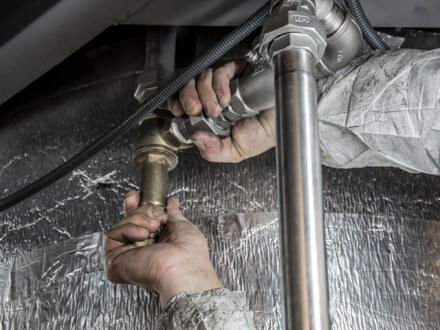
Training for HVAC and refrigeration work in Maine can pay off, but the upfront cost can sting. Tuition, lab fees, hand tools, steel-toe boots, and EPA exam costs can push a student's first-year bill from $5,000 to $12,000 fast, depending on the school and program length.
That's why Maine Refrigeration and Air Conditioning Mechanic Scholarships matter. They can reduce how much a student borrows, cut the need for part-time work, and make it easier to finish training on time. For many students, even a $1,000 award covers textbooks, gauges, or a chunk of tuition.
Students often assume scholarships are only for straight-A seniors heading to a four-year campus. That's not true. Maine students can find aid through community colleges, trade groups, workforce programs, local foundations, employers, and even national HVAC scholarship pools. Some awards are built for high school seniors. Others fit first-year students, college students in technical programs, or university students studying related fields like mechanical systems, construction management, or energy engineering.
The list below breaks down 10 realistic scholarship paths students can use to help pay for refrigeration and air conditioning mechanic training in Maine. Each path includes who it fits best, what to look for, and how a student can make a stronger application.
1. Maine Community College Scholarships For HVAC And Refrigeration Programs
Community colleges are often the most direct path into the trade. For students searching for Maine Refrigeration and Air Conditioning Mechanic Scholarships, this is usually the first place to look because many HVAC and refrigeration students start in certificate programs that last 2 semesters or associate tracks that run 4 semesters.
A school-based scholarship can be easier to win than a huge national award. The applicant pool is smaller, and the committee already understands tool costs, lab courses, and technical training.
Students should ask financial aid offices about awards tied to:
- enrollment in a skilled trades program
- GPA or attendance
- county of residence
- need-based aid
- emergency funds for books, tools, or licensing fees
A practical example helps. If tuition is $6,400, books are $850, and tools cost $1,150, a student needs $8,400 before transport or housing. Two campus awards worth $1,500 each can knock that bill down by more than a third.
Students should also widen the search beyond HVAC-labeled awards. General Maine scholarships can still help cover refrigeration training. A Maine-based option such as the Maine State Society award may fit students with strong academic or community ties, even when the program itself is technical.
The smart move is simple: apply for every campus scholarship that allows trade, technical, or workforce training. The label matters less than whether the money can be used at the school.
2. Maine Refrigeration And Air Conditioning Mechanic Scholarships For High School Students
Maine Refrigeration and Air Conditioning Mechanic Scholarships for High School Students often start showing up before graduation. That matters because many deadlines land in late winter or early spring, months before a student ever steps into an HVAC lab.
High school seniors have more options than they think. Scholarship committees like applicants who can show attendance, work ethic, and a clear trade plan, even if they do not have a perfect transcript.
Strong application proof can include:
- a shop class project with photos
- a part-time job in maintenance or construction
- dual-enrollment credits
- teacher recommendations from math, physics, or CTE classes
- volunteer work fixing equipment at a fairground, church, or community site
A concrete example: a senior who earned a 3.1 GPA, completed 120 hours in a building trades class, and worked 10 hours per week at a hardware store may look more compelling than a student with higher grades but no trade direction.
Maine students should also search broad local programs that reward service, leadership, or regional roots. A student active in youth development programs might fit the Maine 4-H scholarships, while students from military families may qualify for Maine American Legion awards.
The big mistake is waiting until graduation week. Students who start 6 to 8 months before enrollment usually find more money, write better essays, and miss fewer deadlines.
3. Maine Refrigeration And Air Conditioning Mechanic Scholarships For First-Year Students
Maine Refrigeration and Air Conditioning Mechanic Scholarships for first-year students matter because the first term is often the most expensive one. A new student may need tuition, lab fees, protective gear, gauges, hand tools, and exam prep materials all at once.
First-year students should not assume they missed their chance if they did not win money as seniors. Many scholarships open after a student has completed 1 semester and can show real grades in electrical theory, refrigeration cycles, or blueprint reading.
That makes first-year applications stronger because the student can point to:
- a completed GPA in college-level classes
- instructor feedback
- lab attendance
- EPA 608 exam progress
- a clear plan for summer work or apprenticeship placement
There's a strong career case for sticking with it. The U.S. Bureau of Labor Statistics reports 9% job growth for heating, air conditioning, and refrigeration mechanics and installers, which is faster than average across all occupations. That kind of demand helps scholarship committees feel they are funding a field with real job openings.
A first-year student can also look at specialized awards outside Maine. For example, the Taylor Refrigeration scholarship shows how niche refrigeration-focused scholarships can support students who already know their trade direction.
First-year applicants do best when they replace vague language with specifics. "I want a good job" is weak. "I completed 14 credit hours, passed refrigeration fundamentals, and plan to test for EPA Type II within 60 days" is much better.
4. Maine Refrigeration And Air Conditioning Mechanic Scholarships For College Students In Technical Programs
Maine Refrigeration and Air Conditioning Mechanic Scholarships for College students in technical programs often reward momentum. Once a student is already in a trade program, scholarship committees can judge actual performance instead of guesses.
That helps students in HVAC, building systems, electrical technology, welding, and industrial maintenance. These fields overlap in the real job market, especially for refrigeration mechanics who deal with motors, controls, piping, airflow, and troubleshooting.
A strong technical-program application usually shows measurable progress, such as:
- 24 completed credits
- a 3.0 or higher GPA in major courses
- perfect or near-perfect lab attendance
- OSHA or EPA credentials
- instructor comments about troubleshooting skill
A good example is a second-semester student who rebuilt control wiring on a training unit, documented the fault, and cut diagnostic time from 45 minutes to 18 minutes. That kind of detail stands out more than generic statements about being hardworking.
Students should also look at broader trade funding. The Maine Trade Scholarship can fit applicants whose training leads directly to hands-on careers, even if the award is not limited to HVAC alone.
This is also where Studentscholarships.org can be useful. Its free scholarship search format helps students sort awards by major, state, and education level instead of digging through dozens of unrelated pages. For a busy technical student taking labs, even saving 2 hours per week on scholarship hunting makes a difference.
5. Maine Refrigeration And Air Conditioning Mechanic Scholarships For University Students Pursuing Related Degrees
Not every future refrigeration or HVAC professional starts in a pure trade certificate. Maine Refrigeration and Air Conditioning Mechanic Scholarships for University students can also matter for those studying related fields like mechanical engineering technology, construction management, energy systems, facilities management, or building science.
These students may end up designing, managing, or optimizing the systems that technicians install and repair. In large hospitals, food processing plants, and campus buildings, that overlap is real. One chiller issue can affect hundreds of rooms or spoil thousands of dollars in temperature-sensitive goods.
University students should target scholarships that mention:
- engineering or applied science
- sustainability or energy efficiency
- workforce development
- manufacturing and industrial systems
- Maine residency or community service
A student pursuing a related degree can still make a strong HVAC case by showing field exposure. For example, a construction management student who spent 160 internship hours tracking ductwork coordination and rooftop unit schedules has a clear connection to the trade.
Broader Maine awards can help here too. The Maine Manufacturers scholarship may suit students aiming at industrial systems work, where refrigeration, process cooling, and plant maintenance often overlap.
University applicants should frame themselves carefully. They do not need to pretend they are in the exact same lane as a service technician. They just need to prove that their degree supports Maine's heating, cooling, refrigeration, or mechanical infrastructure.
6. Maine Refrigeration And Air Conditioning Mechanic Association Scholarships And Trade Industry Awards
Maine Refrigeration and Air Conditioning Mechanic Association Scholarships can be some of the best-fit awards because trade groups know exactly what the work requires. They understand that a student may need manifold gauges, recovery tools, work pants, exam fees, and gas money for job sites, not just a generic tuition check.
Industry awards usually favor students who show they are serious about the field. That can mean hands-on skill, employer references, chapter involvement, or a plan to stay in Maine after training.
Trade association applications often ask for:
- a short essay on career goals
- proof of program enrollment
- a transcript
- a recommendation from an instructor or employer
- evidence of participation in skills competitions or work-based learning
A useful benchmark: the EPA Section 608 credential has 4 certification types. A student who already passed Core plus Type II or Universal shows concrete progress, which can lift an application above the pile.
Students should not ignore adjacent association awards either. A local scholarship from a construction, manufacturing, or business group may still support refrigeration training if the applicant explains the connection clearly. The key is showing that HVAC and refrigeration keep restaurants, warehouses, schools, and production spaces running.
This category rewards focus. If a student can say, "I want to work on low-temperature commercial systems for grocery and seafood storage," that sounds more believable than "I like working with my hands." Specific trade goals tend to win.
7. Apprenticeship-Linked Scholarships From Employers, Unions, And Workforce Programs
Apprenticeship-linked funding is one of the most practical ways to lower training costs. Instead of paying for school first and hoping a job appears later, students connect training with actual employers, union pathways, or workforce partnerships.
That setup can cut out-of-pocket costs in more than one way. A student might get $1,200 for books, $800 for tools, and paid work hours during training. Even a modest wage of $18 per hour adds up quickly over a 20-hour workweek.
These opportunities often come through:
- HVAC contractors
- sheet metal or pipe-related unions
- regional workforce boards
- employer tuition assistance plans
- pre-apprenticeship partnerships with technical schools
Employers like this model because it builds a pipeline. If a contractor needs service techs for walk-in coolers, heat pumps, and rooftop units, helping one student now may solve a staffing problem later.
A strong applicant shows reliability first. Employers care about attendance, a clean driving path toward license eligibility, and the ability to show up at 6:30 a.m. ready for a cold rooftop or a hot mechanical room.
Key Documents Students Should Prepare Before Applying
Students should gather documents before deadlines hit. Doing this early can cut application time from 90 minutes to 25 minutes.
The basic file should include:
- transcript or grade report
- résumé with work hours and skills
- proof of enrollment or acceptance
- one general essay and one trade-focused essay
- 2 recommendation letters
- FAFSA summary, if required
- copies of certifications such as OSHA or EPA exam results
Students who keep these files in one folder usually submit more applications, and more applications usually mean more chances at funding.
8. State Workforce Grants And Maine Skilled Trades Funding Opportunities
State workforce funding can be a huge help for students who do not fit the classic scholarship picture. Some are recent high school graduates. Others are career changers, laid-off workers, parents returning to school, or adults moving from retail into the skilled trades.
These programs may come as grants, not scholarships in the usual sense, but the effect is the same: less money out of pocket. In some cases, funding covers tuition. In others, it can also help with books, mileage, child care, or required gear.
Students should ask about programs tied to:
- high-demand occupations
- short-term credential training
- displaced worker support
- income-based eligibility
- employer-sponsored upskilling
The logic is strong. HVAC and refrigeration work supports homes, schools, seafood processing, grocery storage, health care facilities, and commercial buildings across Maine. When one trained mechanic keeps a supermarket cooler running, that can protect tens of thousands of dollars in food inventory.
Students who qualify for workforce funding should still stack it with scholarships when the rules allow. A grant may cover tuition, while scholarship money covers tools and travel. That can be the difference between borrowing $4,500 and borrowing $0.
This path works especially well for students who missed early scholarship deadlines. Workforce offices often run on rolling or seasonal timelines, which can open doors after a college award cycle has already closed.
9. National HVAC, Mechanical, And Construction Scholarships Maine Students Can Use
A lot of Maine students search only for local money and miss national awards. That is a mistake. National HVAC, mechanical, and construction scholarships can often be used at eligible Maine schools, and some have less local competition because fewer students bother to apply.
These awards may come from:
- trade foundations
- national contractor groups
- building industry associations
- refrigeration manufacturers
- construction education nonprofits
The upside is scale. A local scholarship might offer $500 to $1,500, while a national award may offer $2,500, $5,000, or more. Even one win can cover a full semester of tuition at some technical programs.
Students should read the eligibility line by line. Some awards require a declared major. Others accept related programs like mechanical systems, electrical technology, or construction management. A Maine student in an HVAC pathway can still fit if the application explains the connection clearly.
This is another place where broader scholarship databases save time. A student comparing trade-specific results with state-level options may find unrelated-looking awards that still apply because they are open to technical majors, Maine residents, or workforce-bound students.
National applications also reward better storytelling. A student who writes about diagnosing a freezer case that drifted from -10 degrees to 8 degrees during school lab work sounds real. Committees remember that level of detail.
10. Local Foundation And Regional Scholarship Opportunities For Maine Trade Students
Local foundations are easy to overlook, but they can be some of the best odds on the board. A county fund, regional donor, civic club, or Maine employer-backed scholarship may draw 40 applicants instead of 400. That changes the math fast.
For Maine trade students, local awards often care about community roots, school involvement, work history, and plans to stay in the state. That fits HVAC and refrigeration students well because these jobs are local by nature. A technician serves homes, schools, stores, and plants in real towns, not some vague national market.
Regional scholarships can come from:
- community foundations
- chambers of commerce
- local employers
- county memorial funds
- civic groups and service clubs
Students should cast a wide net. A broad Maine-centered award like the Lamey Wellehan scholarship can support students with strong in-state ties, while a local option such as the WBRC Centennial award may fit applicants from a specific region or profile.
How To Match Scholarships To High School, College, Or University Status
Students should sort scholarships by status before they start writing. That alone can save 3 to 5 hours and reduce wasted applications.
A simple match system works well:
- High school students: focus on senior-year, community, and entry-to-trade awards
- First-year students: target awards that want first-semester grades or proof of enrollment
- College students in technical programs: apply for trade, workforce, and program-specific aid
- University students: look at related-degree, engineering, energy, and industrial awards
The best applications match the student's real stage. A high school senior should not sound like a licensed mechanic. A second-year HVAC student should not write like someone still guessing about career plans.
Maine Refrigeration and Air Conditioning Mechanic Scholarships FAQs
What types of scholarships are available for Maine students pursuing refrigeration and air conditioning mechanic training?
Maine offers scholarships from community colleges, trade associations, local foundations, employers, workforce programs, and national HVAC funds. These awards cater to high school seniors, first-year students, college technical programs, and university students in related degrees.
How can high school students in Maine strengthen their applications for refrigeration mechanic scholarships?
High school applicants should showcase trade-related activities like shop projects, part-time jobs in maintenance, dual enrollment credits, and teacher recommendations. Applying early and highlighting community service or leadership roles can also improve chances.
Are there scholarships specifically for first-year HVAC or refrigeration students in Maine?
Yes, several scholarships target first-year students covering expenses like tuition, tools, and exam fees. These often require proof of enrollment, completed coursework, GPA, lab attendance, or progress toward EPA certifications to strengthen applications.
Can Maine university students studying related fields qualify for refrigeration mechanic scholarships?
University students in mechanical engineering technology, construction management, or energy systems can apply for scholarships that focus on workforce development, sustainability, or industrial systems, especially if they demonstrate field exposure related to HVAC.
What are apprenticeship-linked scholarships, and how do they benefit Maine refrigeration mechanic students?
Apprenticeship-linked scholarships tie training with employers, unions, or workforce programs, often providing tool funds, tuition assistance, and paid work hours. They help reduce upfront costs and build career pipelines in Maine's HVAC industry.
Where can Maine students find local scholarships with better chances of winning for refrigeration training?
Local foundations, county funds, chambers of commerce, and civic clubs offer scholarships with smaller applicant pools. Programs like the Scholarship Application - WBRC Centennial Scholarship are ideal for students with strong community ties planning to stay in Maine.






