

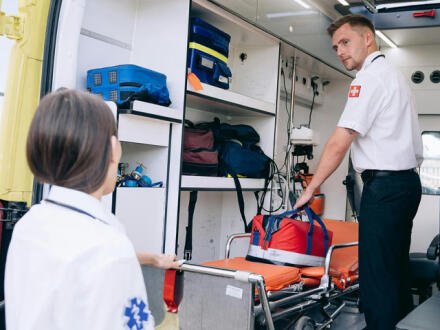
Paying for EMT training in Oklahoma can feel simple at first, then expensive all at once. Tuition might be manageable, but the real bill often includes books, CPR certification, uniforms, background checks, immunizations, and testing fees. A student who pays $1,250 for training, $190 for books, $85 for CPR, and $120 for exam costs is already at $1,645 before gas or childcare.
That's why Oklahoma Emergency Medical Technician Scholarships matter so much. They don't just cover classes. They can reduce the small, annoying costs that stop students from finishing.
The good news is that scholarship money for EMT students is not limited to one kind of applicant. High school seniors, first-year students, adult learners, community college students, and university students can all find options if they search the right places in the right order. And timing matters. A student who starts in September usually sees more opportunities than a student who starts two weeks before class.
This guide walks through 7 practical ways to find Oklahoma Emergency Medical Technician Scholarships and similar aid. It also points out where students usually overlook funding, how to stack multiple awards, and which application materials can make a real difference. For students using a free scholarship platform such as StudentScholarships.org, that means less random searching and more focused applications that actually fit EMT career goals.
1. Start With Oklahoma EMT Scholarships Offered Through State Career Tech And EMS Training Programs
The first stop should be career tech centers, EMS academies, and training providers inside Oklahoma. This is where many students miss money because they search broad scholarship websites first and local training offices second.
Oklahoma EMT programs often know about small awards before they appear anywhere else. Some schools have emergency assistance funds, tuition offsets, fee waivers, or short application cycles that never get much public attention. A program director may know about a $500 rural workforce award or a book stipend for 12 students long before a search engine does.
Students should ask each school these exact questions:
- Is there a scholarship tied to the EMT cohort itself?
- Are testing fees covered for any students?
- Does the school have donor-funded aid for health programs?
- Are there discounts for volunteer firefighters or EMS explorers?
- Can federal aid apply to this certificate?
A concrete example helps. If one career tech charges $1,400 for EMT tuition and offers a $750 in-house scholarship, that cuts the training bill by 53.6%. That is much better than spending six weeks applying for unrelated national awards worth $250.
Students should also ask whether the EMT program is connected to a larger health science track. Sometimes aid is listed under allied health, public safety, or workforce development, not under "EMT." That naming detail matters.
Another smart move is to request a full cost sheet, not just tuition. Schools may list:
- Tuition
- Lab fees
- Textbooks
- Uniforms
- Drug screening
- Background check
- Certification testing
A student who knows the full number can apply for the right amount instead of guessing low and still coming up short.
Who High School Seniors And Adult Learners Should Check First
High school seniors should start with their nearest technology center and any dual-credit or health careers office. Adult learners should begin with the admissions office, financial aid office, and EMS program coordinator at the school where they plan to enroll.
For seniors, school partnerships matter. A student in a health science pathway may already be linked to a career tech center that offers EMT-related training. That connection can open scholarships faster than a cold search. Students active in agriculture, leadership, or service clubs may also match state-based awards such as the 4-H scholarship list when their record shows community involvement and career plans.
Adult learners should ask whether employers, tribal programs, or local workforce offices work directly with the training program. In some cases, an adult student can combine a $600 school award, $400 employer reimbursement, and payment plan support to cover most of a short certificate.
For both groups, speed matters. A program with 24 seats may only have aid for the first 8 accepted students who complete scholarship paperwork. That happens more often than students think.
2. Target Oklahoma Emergency Medical Technician Scholarships For High School Students Before Graduation
Students looking for Oklahoma Emergency Medical Technician Scholarships for High School Students should start before senior spring gets crowded. Once graduation activities hit, deadlines pile up fast and smaller awards disappear.
The best time to build an EMT scholarship plan is during junior year or at the start of senior year. That gives students enough time to collect service records, attendance data, recommendation letters, and proof of career interest. A student who waits until April may still find funding, but the pool is usually smaller.
High school applicants stand out when they show three things clearly:
- A real plan to enter EMS or public service
- Local involvement, such as volunteering, athletics, FFA, 4-H, church service, or health clubs
- Consistency, like steady grades or regular attendance
A strong example is a senior with 86 volunteer hours, a 3.4 GPA, CPR certification, and a short essay explaining how rural ambulance response times shaped career goals. That application feels specific. It gives reviewers something they can remember.
Students should also look beyond EMT-only awards. General Oklahoma scholarships can still fund EMT training if the rules allow career certificates or health education. For instance, applicants with strong state involvement may fit awards like the state fair scholarship page or the Hall of Fame scholarship listing, depending on their background and eligibility.
School Counselors, CTE Pathways, And Local Community Sponsors
School counselors are still one of the best scholarship sources for EMT-bound seniors. They often know about hospital auxiliaries, Rotary clubs, farm organizations, chambers of commerce, and county foundations that give out awards of $250 to $2,000.
Career and Technical Education pathways matter too. A student in health science, first responder, or public safety classes should ask whether the district keeps a scholarship bulletin for workforce programs. Some awards never make it onto national lists because they stay inside district email chains.
Local sponsors are especially useful in small towns. A rural bank, ambulance district, or memorial foundation may only award 2 to 5 scholarships each cycle, but applicant pools can also be tiny. Winning a $1,000 hometown award from 12 applicants is often more realistic than chasing a national scholarship with 4,000 applicants.
Students should ask for these items before graduation:
- An official transcript
- A résumé with hours and activities
- Two recommendation letters
- Proof of FAFSA submission if required
- A one-page career goals statement
That packet makes it easier to apply quickly when a local EMT-related award appears.
3. Explore Oklahoma Emergency Medical Technician Scholarships For College Students Enrolled In Certificate Or Associate Programs
Students already in college should focus on program-based aid, health division scholarships, and foundation awards. This is the best lane for students searching Oklahoma Emergency Medical Technician Scholarships for College because many schools bundle EMT funding inside broader healthcare categories.
Community colleges and technical colleges often support certificate and associate students through campus foundations. The mistake many applicants make is filtering only for "EMT." A better search also includes:
- Emergency medical services
n- Allied health
- Health sciences
- Workforce certificate
- Public safety
- Community service
College students have one big advantage over high school seniors: they can show actual performance in college classes. A student with 15 completed credit hours, a 3.2 GPA, and perfect attendance in anatomy or medical terminology looks more proven than a student with only future plans.
Financial aid offices may also know whether a certificate is eligible for Pell Grant support or other campus-based help. Even if a specific EMT scholarship is small, it can plug a gap. For example, a student with a $2,100 tuition balance might use a $1,250 Pell award, a $500 campus scholarship, and $350 from a local donor fund to close the whole amount.
Students in health programs should also scan related medical scholarship pages because some awards are broader than the title suggests. A campus advisor may suggest options similar to an Oklahoma nurses award if the funding rules include health training or service careers.
Another useful tactic is asking whether the college foundation awards by county, family income, or first-generation status. Those filters can uncover aid that has nothing to do with EMS on the surface but still pays for EMT school.
To improve odds, college students should submit:
- Their current transcript
- A short budget showing exact unmet need
- Clinical or volunteer hours if available
- A clear explanation of where EMT training fits into career goals
That last point matters. A student who writes "I want to help people" sounds generic. A student who writes "I plan to earn EMT certification, work part time on a county ambulance, then bridge into paramedic school" sounds real.
4. Look For Oklahoma Emergency Medical Technician Scholarships For University Students In Allied Health And Prehospital Care Tracks
University students often assume EMT scholarships are only for career tech or community college students. That is not always true. Students in allied health, public health, exercise science, nursing prep, or prehospital care tracks may still find funding that supports EMT coursework.
This is where Oklahoma Emergency Medical Technician Scholarships for University become a wider search. Instead of focusing only on the certificate title, students should search for aid linked to service careers, health workforce needs, rural practice, and clinical preparation.
A university student planning medical school, physician assistant training, nursing, athletic training, or emergency management may use EMT training as a career step and resume builder. That makes the scholarship case stronger. It shows purpose, not a side hobby.
One useful example: a student receives a $1,800 departmental scholarship from a health sciences unit, then uses $950 of that to cover EMT tuition and the rest for books and campus fees. The scholarship was not labeled "EMT," but it still reduced EMT training costs in a very real way.
University students should ask these offices for leads:
- Department chair or program director
- College of health sciences
- Pre-professional advising office
- Honors program
- Student success center
- Financial aid office
Students with strong academic profiles may also qualify for broader Oklahoma awards that can be used toward related educational costs. For instance, applicants in rural or service-minded programs may find overlapping opportunities through resources like the rural rehabilitation scholarship page.
How University-Based Aid Can Overlap With EMT Training Costs
University-based aid can overlap with EMT costs in three common ways. First, a scholarship refund may be used for approved education expenses after tuition posts. Second, a department may reimburse career credentials tied to clinical readiness. Third, a student can stack general aid with a short external award.
Here's a concrete scenario:
- University scholarship refund: $900
- EMT textbook cost: $210
- CPR and immunization updates: $145
- Testing and background check: $245
- Remaining amount toward tuition: $300
That one refund covers more than people expect.
Students should confirm spending rules before counting on it. Some aid only applies to institutional charges. But when it can be used flexibly, it turns a general university scholarship into real EMT support.
This strategy matters most for students trying to build clinical exposure before applying to higher-level health programs. EMT certification can add paid patient-care hours, field experience, and a clearer career story, all while reducing the need for unpaid résumé building.
5. Prioritize Oklahoma Emergency Medical Technician Scholarships For First-Year Students With Strong Service Potential
First-year students sit in a sweet spot. They are new enough to qualify for freshman-focused awards, but old enough to show commitment through coursework, work history, or community service. That makes Oklahoma Emergency Medical Technician Scholarships for first-year students especially worth chasing.
Scholarship committees often like first-year applicants because they can invest early and track results over time. A student entering an EMT pathway with a clear public-service goal can be a strong bet, especially in counties where ambulance staffing is thin.
What does "service potential" look like in practice? Usually some mix of:
- Volunteer work
- Leadership roles
- Reliable attendance
- Interest in rural or underserved communities
- Clear plans for EMS, fire, hospital transport, or paramedic progression
A first-year student who worked 18 hours per week, completed 42 service hours, and still earned a 3.1 GPA has a compelling story. Reviewers often read that as stamina and follow-through.
This is also a good stage to search national healthcare and allied-health scholarships that allow undergraduate members or certificate learners. Students exploring professional organizations may find options through an AMT scholarship listing, especially if their training path connects to broader medical credentials later on.
Another smart move is to submit applications even when the award is modest. Three separate awards of $500, $750, and $1,000 add up to $2,250. That can cover most EMT certificate costs at many schools.
Application Materials That Help First-Year Applicants Stand Out
First-year applicants usually win with clarity and proof, not fancy writing. Reviewers want a student who sounds real and prepared.
The strongest application packet often includes:
- A résumé with exact hours, roles, and dates
- A transcript showing first-semester performance
- One academic recommendation and one character reference
- A budget with exact costs
- A short essay tied to service, not just ambition
Specificity helps a lot. Compare these two lines:
- Weak: "They want to help people."
- Strong: "They spent 64 hours volunteering at football games and county fairs, then chose EMT training after seeing how often heat illness and falls needed fast care."
That second version gives a picture. It feels grounded.
Students should also mention practical details such as transportation, family responsibilities, and work schedules when relevant. If a $700 scholarship would allow them to drop one weekend shift and finish required labs, that is useful information. It shows how the award changes the outcome, not just the bank balance.
6. Check Oklahoma Emergency Medical Technician Association Scholarships And Other Professional Organization Awards
Professional associations are often overlooked because students assume membership groups only help people who are already established. That's not always true. Many student-facing awards exist through associations tied to medicine, emergency response, and workforce development.
For students searching Oklahoma Emergency Medical Technician Association Scholarships, the key is to search both state and national groups, then read eligibility rules closely. Some awards are open to:
- Students in approved health programs
- Members or family members of members
- Residents of a specific state
- Students entering a shortage field
- Applicants with service or leadership records
These awards can be smaller, but they are often less crowded. A $1,000 association scholarship with 70 applicants is a better bet than a flashy $10,000 award with 6,000 applicants.
Students should also think across related professions. An EMT student who plans to move into nursing, respiratory care, or another patient-care track may qualify for adjacent health scholarships depending on the rules. Broader career groups can matter too. For example, women entering technical or science-linked training may find relevant paths through the women in tech award if eligibility fits their education plan.
The most common mistakes with professional organization awards are simple:
- Missing membership deadlines
- Forgetting proof of enrollment
- Reusing a generic essay
- Ignoring tiny details like file names or signatures
Students should keep a spreadsheet with columns for deadline, membership need, essay prompt, transcript requirement, and award amount. Even a list of 12 opportunities becomes much easier to manage when every field is visible.
Finally, students should ask EMS instructors whether they belong to associations that sponsor scholarships or conference awards. Faculty referrals matter. Sometimes one email from an instructor points a student to a fund that never appeared in public searches.
7. Combine Local Scholarships, Employer Sponsorships, And Rural Workforce Grants To Maximize Funding
The smartest funding plan usually comes from stacking, not waiting for one perfect scholarship. Students who combine local awards, job-based support, and workforce money often end up with the strongest results.
This works because EMT training costs arrive in layers. One source might pay tuition. Another might cover books. A third might reimburse exam fees after completion. When students treat funding as a package, they stop putting all the pressure on one application.
A realistic stack can look like this:
- Local civic scholarship: $750
- Volunteer fire department sponsorship: $500
- Rural workforce grant: $1,000
- Employer reimbursement after passing: $400
That total is $2,650. For many Oklahoma EMT students, that can cover nearly all direct training costs.
Employer support is especially useful. Ambulance services, hospitals, clinics, and fire departments may help if the student agrees to work a set period after certification. Even a modest agreement can matter. If an employer covers 50% of a $1,600 program, that saves $800 right away.
Rural workforce funding should get special attention. Smaller communities often need trained responders badly. A county with long transport times or staffing shortages has a real reason to invest in local trainees. Students from those areas should ask:
- Is there county EMS sponsorship?
- Does the hospital foundation support EMTs?
- Are workforce boards funding short-term healthcare training?
- Are tribal education departments offering grants?
Students can also widen their local search through general Oklahoma scholarship databases. A community-based listing such as the housing scholarship page may not mention EMT training in the title, but it can still reduce the total education bill if the eligibility rules line up.
The main rule is simple: never stop after one "no." A student who applies to 9 local and regional opportunities and wins just 2 awards averaging $850 still gains $1,700. That is enough to change whether training starts this term or gets delayed for months.
Oklahoma Emergency Medical Technician Scholarships: Common Questions
What types of costs can Oklahoma EMT scholarships help cover beyond tuition?
Oklahoma EMT scholarships often assist with additional costs like books, CPR certification, uniforms, background checks, immunizations, and testing fees, which together can add up significantly beyond just tuition expenses.
How can high school seniors maximize their chances of receiving Oklahoma EMT scholarships?
High school seniors should apply early, ideally during junior year or early senior year, show a clear plan for an EMS career, demonstrate local community involvement, maintain steady grades, and provide comprehensive application materials including transcripts, recommendations, and career essays.
Are Oklahoma EMT scholarships available for college and university students enrolled in related health programs?
Yes, college and university students in allied health, emergency medical services, public safety, or prehospital care tracks can find scholarships that support EMT training often included under broader health sciences or workforce development awards.
What strategies can first-year EMT students use to secure scholarship funding in Oklahoma?
First-year students should highlight strong service records, leadership roles, and commitment to rural or underserved EMS careers. Submitting detailed resumes, transcripts, recommendations, budgets, and service-focused essays improves scholarship prospects.
Can professional organizations provide scholarships for Oklahoma EMT students?
Yes, associations linked to emergency medical services and healthcare often offer scholarships to students, including those just starting training. These awards tend to have fewer applicants and can significantly supplement EMT education funding.
How can students effectively combine multiple funding sources to pay for EMT training in Oklahoma?
Students can stack local scholarships, employer sponsorships, rural workforce grants, and association awards to cover tuition, books, and fees. For example, combining a local civic scholarship, fire department sponsorship, and rural grant can fully fund most EMT program costs.







