
A year ago, the average student workflow ended with a spellcheck, a quick format pass, and a nervous click on Submit. That moment feels different now.
AI writing tools moved into everyday academic life so quickly that verification followed closely behind. Drafts get polished with digital help, outlines get shaped faster, and then a new question appears at the end of the process: how will this text read to a detector?
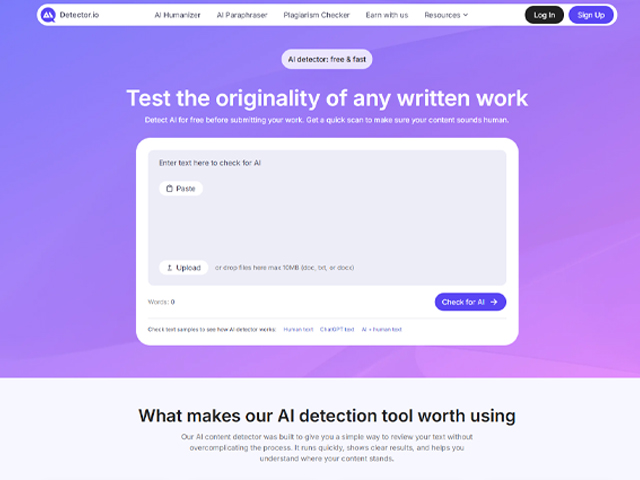
As an AI detector free to access in the browser, Detector.io reflects a very current habit. Students are no longer only editing for grammar or clarity. Many now check content with Detector.io before submission to see how their writing may look to automated systems. The tool fits that new rhythm by offering a fast scan, a clean interface, and a score that adds one more layer of feedback before the file leaves their screen.
The New Step Before Submission: Running an AI Detector Tool
The last few minutes before submission used to feel simple. Fix a typo. Check the header. Export the file.
Now there is often one extra stop in the process, and it says a lot about where school has landed. Students open an AI detector because the fear is no longer limited to actual misuse. Plenty of people want reassurance about work they wrote themselves, especially if they used AI for brainstorming, structure ideas, or light editing.
That shift matters because it turns detection into a self-check habit. It becomes part of the student workflow, part caution, part curiosity, and part damage control.
Students often run their own scan to:
- See whether a fully human draft still triggers suspicious signals
- Check mixed drafts that started with AI help and ended in their own voice
- Understand which passages feel too polished or too predictable
- Avoid awkward surprises during grading
Detector.io fits neatly into that moment. The tool offers a quick way to detect AI before submitting written work, which mirrors exactly how many students now use these platforms.
Where Detector.io Fits in the Detection Landscape
The AI detection space is getting crowded, but not every product plays the same role. Some tools feel built for heavy institutional use. Others feel closer to quick consumer checks.
Detector.io sits in an interesting middle spot. It is accessible enough for students who want a fast read on their own draft, yet its positioning also speaks to broader academic-integrity concerns that matter in schools and universities.
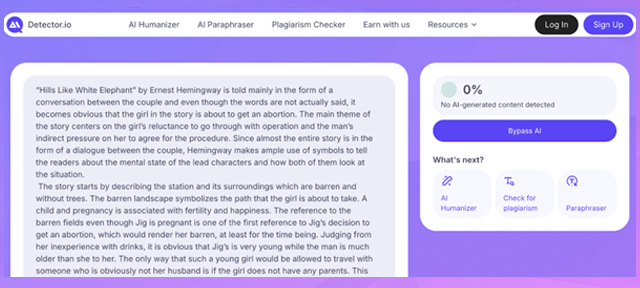
That dual role is part of why the platform feels current. Detector.io is fast, free, and easy to use, with simple browser access and a results screen designed to keep things readable. Its reports highlight sections of text that appear AI-generated.
Detector.io can also function as an AI detector for teachers just as easily as it can serve students. An instructor may care about spotting suspicious passages in submitted work. A student may care about cleaning up the same kind of passage before the file ever reaches the classroom. Same system, different pressure.
How the AI Text Detector Reads the Signals
The interesting thing about Detector.io is that it is looking for patterns. The tool analyzes sentence structure, word distribution, repetition, and the general predictability or uniformity of language rather than relying on simple keywords or surface clues.
It compares a submitted text against large datasets of human and machine-generated writing, then estimates how strongly the draft aligns with AI-like patterns.
In practice, that means the system is looking for writing that feels statistically smooth, too even, or oddly consistent. Human writing usually carries friction.
An AI detector usually pays attention to signals like:
- Predictability in word choice
- Repeated phrasing patterns
- Low variation in sentence rhythm
- Uniform structure across the passage
Detector.io turns those signals into a probability score and can highlight sections that appear AI-generated.
Why Students Use This AI Detector Tool on Their Own Work
The student side of this story is more layered than people often admit. Many students are not scanning their work because they copied a chatbot response and hope to get away with it. A lot of them are scanning because academic writing now lives in a blurry space. A person might draft the argument themselves, ask AI for outline help, rewrite half the essay, then still worry that the final version sounds too machine-clean.
That is why access matters. When you get an AI detector free of charge, the barrier to checking drops. With Detector.io, users can scan up to 3,000 words per check after creating an account, which fits the size of many student assignments.
There is also a learning angle here. Students start noticing how detection tools react to tone, repetition, and sentence shape. They begin to understand which parts of their writing feel generic or overprocessed.
AI Detection Is Becoming Part of the Writing Workflow
The larger story here has less to do with one tool and more to do with what the tool represents. Detector.io belongs to a growing layer of products built around text authenticity, academic integrity, and content verification. Its broader platform also includes adjacent tools like a plagiarism checker, paraphraser, and AI humanizer. That ecosystem reflects a new kind of writing workflow, one shaped by both generation and scrutiny.
The old sequence was straightforward: draft, revise, submit. The new one has more tension in it: draft → revise → AI check → submit.
That extra pause changes the emotional tone of writing. Students are no longer only asking whether their paper is good. They are asking how it will be interpreted by a machine.
Detector.io feels relevant because it sits exactly inside that pause. It is built for the moment when a writer wants a second opinion from the system before facing the institution.
Conclusion
Detector.io is interesting for more than its score screen or its fast scan. It captures a wider shift in academic life. AI writing tools are now woven into how many students brainstorm, draft, and edit. Detection tools rose alongside them, and now both are shaping the same workflow from opposite ends.
That is why Detector.io feels current. It reflects a world where students are expected to produce polished work and also prove where that work came from. In that environment, a quick scan becomes part of the writing ritual.