

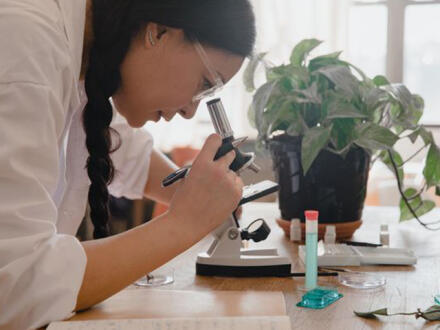
Biochemistry is a smart major, but it can get expensive fast. Lab fees, textbooks, housing, meal plans, and transportation can push a student's college bill far past tuition alone.
For students in New Mexico, the good news is simple: there isn't just one path to funding a biochemistry degree. State awards, university scholarships, STEM grants, need-based aid, and professional association support can all work together. A student might stack a state tuition award with a departmental scholarship and a federal grant, which can cut thousands from yearly costs.
This guide breaks down the most useful options for New Mexico Biochemistry Scholarships and related aid. It covers awards for high school seniors, first-year students, current college students, and transfer students. It also points to broader STEM funding that biochemistry majors often miss.
The goal here is practical help. Each section explains where students should look, what eligibility rules often matter, and how to improve the odds of winning money. For families trying to build a real payment plan, that matters more than vague advice.
Biochemistry students often have an edge because they fit several categories at once:
- STEM major
- Life science student
- Pre-med or research-focused applicant
- State resident pursuing in-state college options
That overlap can open more doors than most students expect.
1. University-Based Biochemistry Scholarships In New Mexico
Many of the best funding options start on campus. Universities often reserve scholarship money for their own students, and that pool can include merit awards, need-based awards, research scholarships, and major-specific support.
For a student searching for New Mexico Biochemistry Scholarships for University programs, the first step is to review the school's scholarship office, financial aid office, and the biology, chemistry, or biochemistry department pages. At larger public schools, those three places may list different awards.
The biggest advantage of university-based scholarships is fit. A school already knows the student's GPA, residency status, major, and enrollment level. That can shorten the application process.
At schools such as UNM, students can often combine campus awards with state aid and federal aid through the financial aid office. That layering matters because even a $1,500 departmental award can cover a full semester of books and lab supplies for some science students.
Students using scholarship search tools like Studentscholarships.org often save time by spotting local awards in one place instead of checking 12 separate pages every week.
Top Schools To Check First
Students looking for biochemistry funding in New Mexico should start with schools that have strong science programs and active financial aid systems:
- University of New Mexico: Large research university with broad aid options and science pathways
- New Mexico State University: Strong STEM support and multiple scholarship channels through the university and colleges
- New Mexico Tech: Especially worth reviewing for students interested in chemistry, lab work, and research-heavy study through New Mexico Tech
A practical approach is to make a spreadsheet with 4 columns:
| School | Scholarship page | Department page | Deadline |
|---|---|---|---|
| UNM | Yes | Yes | Varies |
| NMSU | Yes | Yes | Varies |
| New Mexico Tech | Yes | Yes | Varies |
That simple tracker helps families avoid missing a deadline by 1 day, which happens more often than students think.
2. Departmental Awards For Biochemistry And Related Life Science Majors
Departmental awards are often less crowded than giant national scholarships. That matters because a chemistry or biology department may review 40 applications instead of 4,000.
For biochemistry students, the search should not stop at the word "biochemistry." Many strong awards sit under:
- Chemistry
- Biology
- Molecular biology
- Biomedical sciences
- Life sciences
A student majoring in biochemistry might qualify for all 5 categories. That overlap is one of the easiest ways to expand a scholarship list fast.
Departments usually reward specific traits. Common factors include lab performance, faculty recommendations, research interest, undergraduate assistant work, and GPA in science courses. A student with a 3.4 overall GPA but a 3.8 GPA in chemistry and biology may still be very competitive.
This is also where professors matter. A short recommendation from a lab instructor who has seen a student run assays, write reports, and troubleshoot errors can carry more weight than a generic letter.
Students should ask direct questions, such as:
- Are there awards for undergraduate researchers?
- Are transfer students eligible?
- Do pre-health students qualify?
- Is there funding for summer lab work?
For broader state-based opportunities, some students also review options such as the New Mexico Engineering Foundation program. It is not biochemistry-specific, but STEM-adjacent funding can still reduce the total bill.
One concrete example: a $2,000 departmental scholarship can offset roughly 25% of an $8,000 annual in-state tuition charge at some public institutions. That is real money, not a line on a brochure.
3. New Mexico Biochemistry Scholarships For High School Students
High school seniors should start earlier than they think. Many New Mexico Biochemistry Scholarships for High School Students are not labeled for biochemistry alone, but they still support students who plan to enter a life science or STEM major.
State and local scholarships are especially useful at this stage because they often focus on residency, academic preparation, and college plans. A student who already has AP Chemistry, dual-credit biology, or science fair experience can stand out.
Programs tied to college readiness and in-state attendance deserve close attention. For example, some families review the New Mexico Scholars program while comparing merit-based pathways. Others look at regional awards such as the Davis New Mexico Scholarship if their background matches the eligibility rules.
High school students should also think beyond "science" labels. A scholarship for leadership, community service, rural students, or first-generation students can still help pay for a biochemistry degree.
A strong senior-year checklist includes:
- Official transcript with GPA and rank if available
- ACT or SAT scores if a scholarship still asks for them
- Resume with labs, clubs, volunteering, and jobs
- One core essay that can be adjusted for different prompts
- Two recommendation letters requested at least 3 weeks early
A student who applies to 12 scholarships with an average award of $1,000 does not need to win all 12. Winning 3 awards already creates a $3,000 gap closure.
Early Eligibility Requirements To Watch
Some rules can decide eligibility before the essay even gets read. Students should confirm these details early:
- New Mexico residency requirements
- Minimum GPA, often 2.5, 3.0, or 3.5
- Planned full-time enrollment after high school
- FAFSA completion for need-based or mixed awards
- Deadline timing, which may fall months before graduation
The New Mexico Higher Education Department is one of the best places to verify state aid rules and residency details. That step can prevent a student from building an application plan around an award they do not actually qualify for.
4. New Mexico Biochemistry Scholarships For First-Year Students
The first year of college is a major funding window. Schools want to attract strong new students, so New Mexico Biochemistry Scholarships for first-year students often include some of the largest renewable awards.
This is the point where state scholarships matter a lot. New Mexico residents often look at programs such as the New Mexico Legislative Lottery Scholarship or the related New Mexico Lottery Scholarship. For eligible students, these awards can cover a substantial share of tuition at public colleges.
First-year students should pay attention to renewal terms, not just the first-year amount. An award worth $2,500 per year for 4 years has a total value of $10,000. That is very different from a one-time $2,500 scholarship.
The strongest applications usually show 3 things:
- Academic readiness in science and math
- Clear interest in biochemistry, medicine, biotech, or research
- Follow-through, shown through activities or work history
A student who spent 120 hours volunteering in a hospital lab-adjacent setting, completed dual-credit chemistry, and wrote a sharp essay about enzyme research will usually look more focused than a student with only generic "I like science" statements.
This is also the right stage to compare total cost, not sticker price alone. A college with a listed cost that is $3,000 higher may become cheaper after institutional aid. That happens often enough that students should always compare net price side by side.
5. New Mexico Biochemistry Scholarships For College Students
Current undergraduates often assume the scholarship hunt is over after freshman year. It is not. In fact, New Mexico Biochemistry Scholarships for College students can become easier to target because colleges now have real evidence of academic performance.
A second-year or third-year biochemistry major can point to:
- College GPA
- Completed lab courses
- Research work
- Faculty relationships
- Campus involvement
That is stronger than a high school profile in many cases. A student with a 3.7 college GPA and 2 semesters of undergraduate lab work is often more persuasive than they were 18 months earlier.
College students should look for awards tied to research, retention, and professional preparation. Departments may offer funding for students heading toward graduate school, medical school, pharmacy school, or biotech roles.
This is also where niche scholarships help. A student with service ties, family background, or community involvement may qualify for state-specific awards outside pure science. For example, some applicants may fit the AAUW Las Vegas branch award or the National Guard scholarships, depending on personal circumstances.
A simple habit helps here: set 1 calendar reminder each month to review scholarship pages. Missing a spring deadline by 48 hours can cost a student $1,500 to $5,000. That is a painful way to lose funding.
Students who keep a "scholarship folder" with updated transcripts, resumes, and essays can often finish an application in under 30 minutes instead of scrambling for 3 hours.
6. New Mexico Biochemistry Scholarships For University Transfer Students
Transfer students often get overlooked in scholarship articles, but they should not. Community college students moving into a 4-year biochemistry program can qualify for merit awards, transfer grants, and department support.
For many families, transfer is the cost-control strategy. A student might complete 60 credits at a lower tuition rate, then move into a university biochemistry track for upper-level lab courses. If that student also earns a transfer scholarship worth $2,000 to $4,000, the savings become significant.
Strong transfer applications usually include:
- Solid college GPA, often 3.0 or higher
- Completed prerequisite courses like general chemistry and biology
- Clear degree plan showing readiness for upper-division work
- A short explanation of long-term goals in health, research, or industry
Transfer students should ask admissions and science departments two direct questions: Are departmental scholarships open to transfers, and does transfer status change renewal rules? The answers are not always obvious on the website.
Students coming from New Mexico community colleges may also benefit from in-state alignment. Schools like New Mexico State University and other public campuses often have transfer pathways that make credit evaluation smoother.
A practical example: if a student saves $6,000 by attending community college first and then wins a $3,000 transfer award, that is a combined $9,000 reduction. For many households, that can decide whether a biochemistry degree is financially possible.
7. STEM Scholarships That Biochemistry Students In New Mexico Should Not Ignore
Biochemistry students should not limit the search to awards with "biochemistry" in the title. That is one of the biggest mistakes students make.
Biochemistry fits under the larger STEM umbrella, and that opens many more doors. A student can qualify through science, technology, engineering, mathematics, research, public service, health professions, or workforce development categories.
This broader strategy matters because the pool gets bigger fast. If a student finds 8 biochemistry-specific awards but 27 STEM-related awards, the search becomes much stronger.
Common STEM scholarship sources include:
- State programs for high-demand fields
- University STEM initiatives
- Private foundations
- Industry groups
- Regional nonprofits
Students with overlapping identities should search every angle. For example, a rural student in biochemistry, a first-generation student in STEM, and a woman in life sciences may qualify for 3 different scholarship lanes at once.
Some students also expand into adjacent New Mexico awards such as the 505 Southwestern scholarship when the criteria match their profile. It may not be biochemistry-specific, but money is money when tuition is due.
Professional groups matter too. The American Society for Biochemistry and Molecular Biology supports the field and gives students a useful benchmark for what strong academic and research preparation looks like.
If a biochemistry student applies to only major-specific awards, they might miss 60% to 80% of realistic funding options. Broadening the search can be the difference between 5 applications and 25.
8. Need-Based Financial Aid Options That Can Supplement Scholarships
Scholarships matter, but they rarely cover every cost. That is why need-based aid should sit right beside the scholarship search, not behind it.
For many New Mexico students, the FAFSA is the key first step. It can open access to:
- Federal Pell Grants
- Federal work-study
- Subsidized loans
- State grant aid
- Institutional need-based programs
This matters because grants reduce out-of-pocket cost without repayment. A Pell Grant worth several thousand dollars can combine with state tuition aid and a campus scholarship to create a much better package.
The order matters too. A student may win a $2,000 scholarship, but if they skipped the FAFSA, they could lose access to much larger grant aid. That is a bad trade.
Families should also review state and community funding sources. Organizations connected to the New Mexico Community Foundation and other local groups sometimes support students by region, family background, or financial need.
A useful budgeting method is to build a one-page college cost sheet with 6 numbers:
- Tuition and fees
- Housing
- Food
- Books and supplies
- Transportation
- Grants and scholarships already secured
If the total cost is $22,400 and aid already covers $14,900, the remaining gap is $7,500. That exact number helps families decide whether to chase more scholarships, increase work hours, choose a cheaper housing option, or adjust the college list.
9. New Mexico Biochemistry Association Scholarships And Professional Organization Awards
There is not always a single, obvious pool labeled New Mexico Biochemistry Association Scholarships, but students should still search professional and association-based awards with care. These groups often support science students through chapter grants, conference funding, travel awards, and discipline-based scholarships.
For biochemistry majors, that can include organizations linked to:
- Biochemistry
- Chemistry
- Molecular biology
- Pre-health fields
- Women in science
Professional awards can be smaller, often $500 to $2,500, but they come with extra value. They can strengthen a resume, support conference travel, or connect a student with mentors.
Association funding also tends to reward clear commitment. A student who presents a poster, joins a science club, volunteers at outreach events, or assists in a faculty lab may stand out more than a student with similar grades but less involvement.
This is a smart place to search for stackable funding. One $1,000 association award plus a $1,500 department scholarship and a $3,000 campus grant creates a $5,500 package.
Students should also keep an eye on local and statewide groups that are not specific to biochemistry but still support education. For example, awards such as the NMASBO scholarships show how professional organizations within a state can fund students with the right fit.
The best tactic is simple: search by major plus group type. Try phrases like "biochemistry association scholarship," "chemistry society student award," and "New Mexico STEM association scholarship."
10. Tips To Build A Strong Biochemistry Scholarship Application
A good application does not sound fancy. It sounds specific.
Scholarship readers want clear evidence that the student is prepared, motivated, and worth investing in. For biochemistry students, the best applications usually connect science interest to real action.
What Makes An Application Strong
The strongest applications often include 5 elements:
- A focused essay with a real story, not generic lines about loving science
- Clear academic evidence, such as GPA, coursework, and lab results
- Relevant activities, like science club, hospital volunteering, tutoring, or research
- Strong recommendations from teachers or professors who know the student's work
- Clean presentation, with no typos, missing files, or deadline problems
A concrete example works better than a broad claim. "They spent 86 hours tutoring chemistry students and raised their own grade from a B- to an A" is much stronger than "they work hard."
Essay Tips That Actually Help
The essay should answer 3 quiet questions:
- Why biochemistry?
- Why this student?
- What will the funding make possible?
Useful details include:
- The smell of ethanol in a first lab class
- The moment a gel result finally made sense
- A hospital volunteer shift that pushed the student toward medicine
- A family financial strain that made college planning difficult
Those details make the essay feel real. Readers remember real.
Final Application Habits
Students improve their odds when they:
- Start applications 14 to 21 days before the deadline
- Ask for recommendation letters at least 3 weeks early
- Save essays in a master file for reuse
- Track every award in a spreadsheet with amount, due date, and status
Even small process habits matter. A student who submits 15 polished applications will usually beat a student who rushes 5.
New Mexico Biochemistry Scholarships FAQs
What types of scholarships are available for biochemistry students in New Mexico?
Biochemistry students in New Mexico can access university-based scholarships, departmental awards in biology or chemistry, state scholarships like the New Mexico Legislative Lottery Scholarship, STEM grants, and professional association awards that support life science majors.
How can first-year biochemistry students in New Mexico maximize their scholarship opportunities?
First-year students should apply for renewable state scholarships such as the New Mexico Lottery Scholarship, submit strong applications highlighting science readiness, and explore departmental awards at their campus, for example at the University of New Mexico.
Are there scholarships specifically for transfer students pursuing biochemistry in New Mexico?
Yes, transfer students can qualify for merit awards, transfer grants, and departmental scholarships at institutions like New Mexico State University and New Mexico Tech. Maintaining a good college GPA and completing prerequisites improves their eligibility.
What role does need-based financial aid play alongside scholarships for biochemistry majors in New Mexico?
Need-based aid, accessed via the FAFSA, can include Pell Grants, work-study, and state grants that supplement scholarships. Combining these resources significantly lowers out-of-pocket costs for students pursuing biochemistry degrees in New Mexico.
How can biochemistry students in New Mexico find smaller, association-based scholarships?
Students should explore awards from professional groups such as the American Society for Biochemistry and Molecular Biology and local organizations. These often support conference travel, research projects, or offer smaller scholarship amounts that stack with university aid.
What are effective strategies for building a strong biochemistry scholarship application in New Mexico?
Applicants should write focused essays sharing personal science experiences, provide faculty recommendations from lab instructors, maintain a strong GPA, and organize materials early. Keeping a scholarship tracker helps meet deadlines and apply broadly for best results.






