

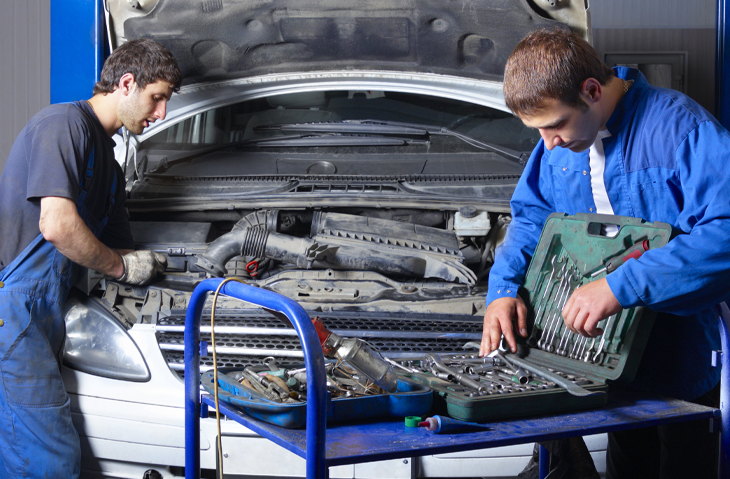
Automotive service technicians inspect, maintain, and repair automobiles and light trucks that run on gasoline, electricity, or alternative fuels, such as ethanol. They perform basic care maintenance, such as oil changes and tire rotations, diagnose more complex problems, and plan and execute vehicle repairs.
Automotive service technicians' and mechanics' responsibilities have evolved from simple mechanical repairs to high-level technology-related work. Today, integrated electronic systems and complex computers regulate vehicles and their performance while on the road. This increasing sophistication of automobiles requires workers who can use computerized shop equipment and work with electronic components while maintaining their skills with traditional hand tools. Technicians must have an increasingly broad knowledge of how vehicles' complex components work and interact. They also must be able to work with electronic diagnostic equipment and digital manuals and reference materials.
When mechanical or electrical troubles occur, technicians first get a description of the problem from the owner or, in a large shop, from the repair service estimator or service advisor who wrote the repair order. To locate the problem, technicians use a diagnostic approach. First, they test to see whether components and systems are secure and working properly. Then, they isolate the components or systems that might be the cause of the problem. For example, if an air-conditioner malfunctions, the technician might check for a simple problem, such as a low coolant level, or a more complex issue, such as a bad drive-train connection that has shorted out the air conditioner. As part of their investigation, technicians may test drive the vehicle or use a variety of testing equipment, including onboard and hand-held diagnostic computers or compression gauges. These tests may indicate whether a component is salvageable or whether a new one is required. Accuracy and efficiency are critical in diagnosing and repairing vehicles, as parts are increasingly expensive, and timely repairs allow shops to take on more business.
During routine service inspections, technicians test and lubricate engines with lubricants and other major components. Sometimes, technicians repair or replace worn parts before they cause breakdowns or damage the vehicle. Technicians usually follow a checklist to ensure that they examine every critical part. Belts, hoses, plugs, brakes, fuel systems, and other potentially troublesome items are watched closely.
Service technicians use a variety of tools in their work. They use power tools, such as pneumatic wrenches, to remove bolts quickly; machine tools like lathes and grinding machines to rebuild brakes; welding and flame-cutting equipment to remove and repair exhaust systems; and jacks and hoists to lift cars and engines. They also use common hand tools, such as screwdrivers, pliers, and wrenches, to work on small parts and in hard-to-reach places. Technicians usually provide their own hand tools, and many experienced workers have thousands of dollars invested in them. Employers furnish expensive power tools, engine analyzers, and other diagnostic equipment.
Computers are also commonplace in modern repair shops. Service technicians compare the readouts from computerized diagnostic testing devices with benchmarked standards given by the manufacturer. Deviations outside of acceptable levels tell the technician to investigate that part of the vehicle more closely. Through the Internet or from software packages, most shops receive automatic updates to technical manuals and access to manufacturers' service information, technical service bulletins, and other databases that allow technicians to keep up with common problems and to learn new procedures.
High technology tools are needed to fix the computer equipment that operates everything from the engine to the radio in many cars. In fact, today, most automotive systems, such as braking, transmission, and steering systems, are controlled primarily by computers and electronic components. Additionally, luxury vehicles often have integrated global positioning systems, accident-avoidance systems, and other new features with which technicians will need to become familiar. Also, as more alternate-fuel vehicles are purchased, more automotive service technicians will need to learn the science behind these automobiles and how to repair them.
Automotive service technicians in large shops often specialize in certain types of repairs. For example, transmission technicians and rebuilders work on gear trains, couplings, hydraulic pumps, and other parts of transmissions. Extensive knowledge of computer controls, the ability to diagnose electrical and hydraulic problems, and other specialized skills are needed to work on these complex components, which employ some of the most sophisticated technology used in vehicles. Tune-up technicians adjust ignition timing and valves and adjust or replace spark plugs and other parts to ensure efficient engine performance. They often use electronic testing equipment to isolate and adjust malfunctions in fuel, ignition, and emissions control systems.
Automotive air-conditioning repairers install and repair air-conditioners and service their components, such as compressors, condensers, and controls. These workers require special training in Federal and State regulations governing the handling and disposal of refrigerants. Front-end mechanics align and balance wheels and repair steering mechanisms and suspension systems. They frequently use special alignment equipment and wheel-balancing machines. Brake repairers adjust brakes, replace brake linings and pads, and make other repairs on brake systems. Some technicians specialize in both brake and front-end work.
Work Environment
Automotive service technicians and mechanics held about 703,800 jobs in 2020. The largest employers of automotive service technicians and mechanics were as follows:
- Automobile dealers - 33%
- Automotive mechanical and electrical repair and maintenance - 28%
- Self-employed workers - 11%
- Automotive parts, accessories, and tire stores - 8%
Service technicians stand for most of the day, and they typically work in well-ventilated and well-lit repair shops. Although technicians often identify and fix automotive problems with computers, they commonly work with greasy parts and tools, sometimes in uncomfortable positions.
Work Schedules
Most service technicians work full time, and many work evenings or weekends. Overtime is common.
Injuries and Illnesses
Automotive service technicians and mechanics frequently work with heavy parts and tools. As a result, workplace injuries, such as small cuts, sprains, and bruises, are common.
Education & Training Required
Most employers regard the successful completion of a vocational training program in automotive service technology as the best preparation for trainee positions. High school programs, while an asset, vary greatly in scope. Graduates of these programs may need further training to become qualified. Some of the more extensive high school programs participate in Automotive Youth Education Service (AYES), a partnership between high school automotive repair programs, automotive manufacturers, and franchised automotive dealers. All AYES high school programs are certified by the National Institute for Automotive Service Excellence. Students who complete these programs are well prepared to enter entry-level technician positions or to advance their technical education. Courses in automotive repair, electronics, physics, chemistry, English, computers, and mathematics provide a good educational background for a career as a service technician.
Postsecondary automotive technician training programs usually provide intensive career preparation through a combination of classroom instruction and hands-on practice. Schools update their curriculums frequently to reflect changing technology and equipment. Some trade and technical school programs provide concentrated training for 6 months to a year, depending on how many hours the student attends each week, and upon completion, award a certificate. Community college programs usually award a certificate or an associate degree. Some students earn repair certificates in a particular skill and leave to begin their careers. Associate degree programs, however, usually take 2 years to complete and include classes in English, basic mathematics, computers, and other subjects, as well as automotive repair. Recently, some programs have added classes on customer service, stress management, and other employability skills. Some formal training programs have alliances with tool manufacturers that help entry-level technicians accumulate tools during their training period.
Various automobile manufacturers and participating franchised dealers also sponsor 2-year associate degree programs at postsecondary schools across the Nation. Students in these programs typically spend alternate 6-week to 12-week periods attending classes full time and working full time in the service departments of sponsoring dealers. At these dealerships, students work with an experienced worker who provides hands-on instruction and timesaving tips.
Those new to automotive service usually start as trainee technicians, technicians' helpers, or lubrication workers, and gradually acquire and practice their skills by working with experienced mechanics and technicians. In many cases, on-the-job training may be a part of a formal education program. With a few months' experience, beginners perform many routine service tasks and make simple repairs. While some graduates of postsecondary automotive training programs often are able to earn promotion to the journey level after only a few months on the job, it typically takes 2 to 5 years of experience to become a fully qualified service technician, who is expected to quickly perform the more difficult types of routine service and repairs. An additional 1 to 2 years of experience familiarizes technicians with all types of repairs. Complex specialties, such as transmission repair, require another year or two of training and experience. In contrast, brake specialists may learn their jobs in considerably less time because they do not need complete knowledge of automotive repair.
Employers increasingly send experienced automotive service technicians to manufacturer training centers to learn to repair new models or to receive special training in the repair of components, such as electronic fuel injection or air-conditioners. Motor vehicle dealers and other automotive service providers may send promising beginners or experienced technicians to manufacturer-sponsored technician training programs to upgrade or maintain employees' skills. Factory representatives also visit many shops to conduct short training sessions.
Other Skills Required
The ability to diagnose the source of a problem quickly and accurately requires good reasoning ability and a thorough knowledge of automobiles. Many technicians consider diagnosing hard-to-find troubles one of their most challenging and satisfying duties. For trainee automotive service technician jobs, employers look for people with strong communication and analytical skills. Technicians need good reading, mathematics, and computer skills to study technical manuals. They must also read to keep up with new technology and learn new service and repair procedures and specifications.
Training in electronics is vital because electrical components, or a series of related components, account for nearly all malfunctions in modern vehicles. Trainees must possess mechanical aptitude and knowledge of how automobiles work. Experience working on motor vehicles in the Armed Forces or as a hobby can be very valuable.
How to Advance
ASE certification has become a standard credential for automotive service technicians. While not mandatory for work in automotive service, certification is common for all experienced technicians in large, urban areas. Certification is available in eight different areas of automotive service, such as electrical systems, engine repair, brake systems, suspension and steering, and heating and air-conditioning. For certification in each area, technicians must have at least 2 years of experience and pass the examination. Completion of an automotive training program in high school, vocational or trade school, or community or junior college may be substituted for 1 year of experience. For ASE certification as a Master Automobile Technician, technicians must pass all eight examinations.
By becoming skilled in multiple auto repair services, technicians can increase their value to their employer and their pay. Experienced technicians who have administrative ability sometimes advance to shop supervisor or service manager. Those with sufficient funds many times open independent automotive repair shops. Technicians who work well with customers may become automotive repair service estimators. They may also find work as educators.
Job Outlook
Employment of automotive service technicians and mechanics is projected to show little or no change from 2020 to 2030.
Despite limited employment growth, about 69,000 openings for automotive service technicians and mechanics are projected each year, on average, over the decade. Most of those openings are expected to result from the need to replace workers who transfer to different occupations or exit the labor force, such as to retire.
Employment
The number of vehicles already in use is expected to continue to rise, and some service technicians will be needed to perform basic maintenance and repair tasks, such as replacing brake pads and changing oil. Increasingly, however, new vehicles are being built with interconnected sensors, cameras, and instruments that allow for predictive maintenance and remote diagnosis, thus reducing maintenance workhours.
Additionally, the increasing prevalence of electric vehicles in the marketplace may limit future demand for automotive service technicians and mechanics, because these vehicles require less maintenance and repair.
Earnings
The median annual wage for automotive service technicians and mechanics was $46,880 in May 2021. The median wage is the wage at which half the workers in an occupation earned more than that amount and half earned less. The lowest 10 percent earned less than $29,010, and the highest 10 percent earned more than $75,100.
In May 2021, the median annual wages for automotive service technicians and mechanics in the top industries in which they worked were as follows:
- Automobile dealers - $47,950
- Automotive mechanical and electrical repair and maintenance - $46,180
- Automotive parts, accessories, and tire stores - $37,610
Many experienced technicians working for automobile dealers and independent repair shops receive a commission related to the labor cost charged to the customer. Under this system, which is commonly known as “flat rate” or “flag rate,” weekly earnings depend on the amount of work completed. Some repair shops pay technicians on an hourly basis instead.
Most service technicians work full time, and many work evenings or weekends. Overtime is common.







