

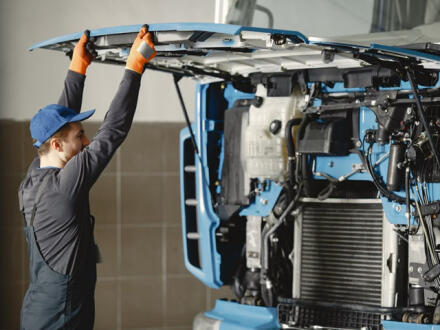
A future diesel tech in Montana doesn't have to cover school costs alone. Students who want to work on pickups, semis, farm equipment, and heavy machines can often stack scholarships, grants, employer help, and school awards to cut tuition by hundreds or even thousands of dollars.
That matters because diesel training is hands-on and tool-heavy. A student might pay for tuition, fees, steel-toe boots, specialty tools, and travel to a campus lab. Even a modest award of $500 to $2,500 can cover a term's books, a starter tool set, or several months of fuel.
Montana diesel engine mechanic scholarships show up in more places than most students expect. Some start in high school. Some are tied to community colleges. Others come from ranching groups, local foundations, tribal programs, or employers that need skilled technicians badly enough to help pay for training.
This guide breaks down 10 practical scholarship paths for students who want diesel, heavy equipment, or applied technology training in Montana. It also points out where students often miss money: local awards with small applicant pools, FAFSA-based aid that can pair with private scholarships, and school-specific programs that don't always show up in a quick web search.
For high school students, college students, and anyone planning the next step, the goal is simple: find the money, stack it smartly, and keep debt as low as possible.
1. High School CTE And Skilled Trades Scholarships In Montana
High school seniors often overlook the most direct path to diesel funding: career and technical education scholarships. These awards are built for students entering trades, not four-year academic majors, so a diesel applicant usually fits well.
In Montana, CTE students can stand out by showing shop experience, FFA or 4-H work, welding classes, small-engine repair, or time spent helping on a family ranch or farm. A committee reading 40 applications will remember the student who rebuilt a hydraulic line on a hay baler more than the one who wrote only broad goals.
Students should start with:
- high school counseling offices
- district CTE coordinators
- local Elks lodges and civic clubs
- county fair and ag groups
- scholarship databases with trade filters
One solid example is the Montana State Elks vocational awards, which specifically align with students entering hands-on training. Awards at this level are often $500 to $2,000, and a student who applies to 8 local programs has a much better shot than a student who applies to 1 national award.
Montana Diesel Engine Mechanic Scholarships For High School Students
When families search for Montana Diesel Engine Mechanic Scholarships for High School Students, the best move is to match diesel goals with local trade language. Many awards won't say "diesel" in the title. They may say vocational, technical, agriculture, mechanics, or workforce.
A strong high school application usually includes:
- a short essay with a specific career plan
- one teacher letter and one employer or ag mentor letter
- proof of CTE, FFA, 4-H, SkillsUSA, or shop coursework
- a resume with exact tasks and hours
A student who writes, "They logged 280 hours in an ag mechanics shop and plan to service heavy trucks in eastern Montana," sounds more credible than a student who simply says they like engines.
2. Community College Diesel Program Scholarships
For many students, community college is the clearest route into diesel work. It usually costs less than a university path, and the training is closer to the job itself: diagnostics, brakes, electrical systems, hydraulics, drivetrains, and preventive maintenance.
That lower price still leaves real bills. A diesel student may need tuition, shop fees, tool purchases, and commuting costs. Community college scholarships can reduce the total enough that a student avoids high-interest private loans.
Students should ask each college three direct questions:
- Are there scholarships just for technical programs?
- Are diesel and heavy equipment students eligible for foundation awards?
- Can outside scholarships stack with school aid?
This matters because schools often have small program-specific funds that never show up on large search engines. A student in a diesel cohort of 18 people might face far less competition than a student applying for a general academic award with 400 applicants.
Montana Diesel Engine Mechanic Scholarships For College
When students search for Montana Diesel Engine Mechanic Scholarships for College, they should think beyond "diesel" as a keyword. Try combinations such as heavy equipment, transportation, welding, ag mechanics, industrial tech, and applied technology.
Community-based awards can help too. The Montana Community Foundation scholarships are worth checking because foundation programs often support students staying in-state for technical training. A student who pieces together one $1,000 award, one $750 local award, and one $500 booster scholarship has already cut $2,250 from the bill.
3. University Transfer And Applied Technology Awards
Not every diesel student stays in a short certificate or two-year track. Some start in a technical program and later move into applied technology, diesel management, construction technology, or education pathways. That's where transfer and university-based awards matter.
A transfer student should look for money tied to:
- applied science degrees
- industrial technology programs
- leadership in technical fields
- transfer enrollment from a two-year school
- strong GPA after the first block of college work
Montana universities also run financial aid offices that help students combine school aid with outside scholarships. For example, the University of Montana's student financial services office outlines how students handle scholarships, costs, and aid coordination through the school system.
Leadership scholarships can also become relevant once a student has college credits and campus involvement. The Montana Presidential Leadership awards show how some university money rewards achievement beyond test scores alone.
For Montana Diesel Engine Mechanic Scholarships for University searches, the key is flexibility. A student moving from hands-on diesel training into supervision, fleet management, or technical instruction may qualify for awards that never use the word diesel. Even a transfer GPA of 3.2 can open doors that weren't available right after high school.
4. First-Year Student Scholarships For Diesel And Heavy Equipment Majors
The first year is when many students leave money on the table. They focus on admission, housing, and class schedules, then miss scholarship deadlines that hit months before the term starts.
First-year awards matter because startup costs are high. A new diesel student may spend $800 to $2,500 on tools, PPE, books, and lab supplies, depending on the program. That's on top of tuition.
The best first-year strategy is simple:
- apply before program admission is final whenever allowed
- reuse one core essay and customize it for each award
- ask for recommendation letters at least 30 days early
- keep a spreadsheet of deadlines, amounts, and documents
Montana Diesel Engine Mechanic Scholarships For First-Year Students
Students looking for Montana Diesel Engine Mechanic Scholarships for first-year students should target awards built for freshmen, career starters, and new vocational students. These scholarships often favor clear intent over a long college resume.
A useful essay formula is:
- explain the type of diesel work they want to do
- show what experience already backs that up
- connect training to Montana employers and local need
A first-year applicant who says they changed injector lines during two harvest seasons, shadowed a fleet mechanic for 60 hours, and plan to maintain Class 8 trucks will read as focused and ready. Specific details beat generic passion every time.
5. Montana Diesel Engine Mechanic Association Scholarships
This is the path many students hope exists: industry association money tied directly to diesel, trucking, construction, or equipment repair. Sometimes the association is statewide. Sometimes it's regional. Sometimes it sits under a construction or transportation trade umbrella instead of using "diesel mechanic" in the name.
That is why students searching for Montana Diesel Engine Mechanic Association Scholarships should cast a wider net. Look at groups connected to:
- contractors
- truck fleets
- road building
- equipment dealers
- agricultural mechanics
A useful comparison is the AGC diesel scholarship application, which shows how contractor-linked trade groups often fund diesel and heavy equipment training with awards in the $1,500 to $2,500 range. Even when an association award is outside Montana, the structure gives students a model for what to look for locally.
Association committees often care about two things: workforce need and follow-through. If a student can show attendance, shop performance, and a plan to work in Montana after graduation, that helps. In a field where employers struggle to fill technician bays, a well-documented applicant can look like a good investment rather than just another student asking for help.
6. Employer-Sponsored Scholarships From Trucking, Agriculture, And Equipment Companies
Sometimes the best Montana diesel engine mechanic scholarships come from employers that are tired of hiring shortages. Trucking companies, farm operations, carry out dealers, and heavy equipment firms all need technicians who can diagnose engines, emissions systems, and electrical faults fast.
Employer support can show up in several forms:
- direct scholarships
- tuition reimbursement after each term
- tool allowances
- paid internships tied to school performance
- work commitments after graduation
Agriculture-linked organizations can be especially useful for students from rural counties. The Montana Farmers Union scholarships are one example of how ag groups support students building practical careers that feed local economies.
Students should ask local employers very direct questions. Do they reimburse credit hours? Do they cover diesel labs? Will they pay $1,000 per semester if the student keeps a 2.5 GPA? Those details are often available, but only if someone asks.
A student who already works part-time washing trucks or assisting in a shop has an edge here. A service manager who has watched that student show up at 6:30 a.m. for months is more likely to support a scholarship request than one reading a cold email from a stranger.
7. FAFSA-Based Grants And Need-Based Aid That Pair With Scholarships
Private scholarships matter, but FAFSA-based aid is the base layer many students need first. Filing the FAFSA can open the door to federal grants, work-study, some state aid, and subsidized loans. Then scholarships reduce what is left.
This pairing is where students gain the most ground. A student might receive need-based aid first, then stack a local vocational award on top instead of borrowing for books and shop costs.
Montana schools explain this process through their aid offices. Montana State University's financial aid office provides the school-side framework students use to manage grants, scholarships, and other funding sources.
A practical FAFSA checklist includes:
- file as early as possible after the form opens
- correct errors fast
- respond to verification requests
- ask how outside scholarships affect the aid package
Concrete example: if a student has a $4,000 remaining gap after grants and school aid, then wins two $1,000 scholarships and gets $600 in tools covered by an employer, the gap drops to $1,400. That can be the difference between a manageable payment plan and added loan debt.
This section matters for every audience group, from high school seniors to returning students. Plenty of good scholarship hunters lose money simply because they skipped the FAFSA step or filed too late.
8. Local Foundation And County Scholarship Opportunities
Local money is often the easiest money to miss. Students tend to search statewide and national databases first, while county foundations, town clubs, and memorial funds sit in plain sight with smaller applicant pools.
For a diesel student in Montana, local awards can be a sweet spot because committees often know the area's need for truck, ag, and equipment mechanics. A county with long winter roads, farm traffic, and ranch equipment breakdowns understands exactly why a good tech matters.
The Montana Community Foundation scholarships are a strong example of foundation-based support, and students should also ask about county-specific funds at local banks, co-ops, and community foundations.
Good local search points include:
- county scholarship bulletins
- electric co-ops
- farm bureaus and ag groups
- local credit unions
- memorial scholarships run through community foundations
A local award may be only $500 or $750, but three small awards can cover a semester of books, fees, and fuel. And in a pool of 12 applicants, the odds can be far better than in a statewide contest with 300 applicants.
Students should also ask if past volunteer work counts. Fair board help, livestock judging support, and community shop projects can make a local application much stronger.
9. Scholarships For Rural, Tribal, And Underserved Montana Students
Montana has huge distances between towns, campuses, and job sites. That makes access a real issue. Rural, Tribal, and underserved students may face extra costs for housing, fuel, child care, or relocation that city-based applicants don't feel the same way.
That is why students should look for scholarships tied to:
- rural residence
- Tribal membership or service to Tribal communities
- first-generation status
- low-income background
- underrepresented students in trades and technical fields
Programs linked to youth development and agriculture can matter here too. The Montana 4-H Foundation scholarships can align well with students whose mechanical skills grew through livestock, ranch, and equipment work.
A strong application should show the real barriers. For example, a student commuting 78 miles each way to a diesel lab twice a week has a very different cost picture than a student living 10 minutes from campus. Those details help committees understand need.
This path is especially important because diesel work supports rural communities directly. When a county has only a few experienced techs, one new graduate can make a visible difference for farms, school buses, logging operations, or local fleets.
10. School-Specific Awards For Diesel, Automotive, And Heavy Equipment Students
The last path is often the most overlooked: school-specific awards offered by the college itself, its foundation, or the department that runs transportation, diesel, automotive, or heavy equipment training.
These awards can be based on need, grades, shop performance, attendance, or instructor nomination. Some are open only to students already in the program, which means the applicant pool can be very small. In a cohort of 20 students, even a $1,000 award becomes much more reachable than a broad scholarship with hundreds of entries.
Students should ask the program office these exact questions:
- Are there department awards separate from general financial aid?
- Do instructors nominate students automatically or by application?
- Are returning students eligible after the first term?
- Is there money for tools, lab fees, or emergency costs?
Memorial awards can matter here too. The Bud Daniels memorial scholarship reflects how Montana-based scholarships often support students building practical careers and community service at the same time.
Students using Studentscholarships.org can save time by filtering for Montana awards, trade-related terms, and quick-apply opportunities. On a busy week, a student might submit 5 to 7 targeted applications in under 2 hours if their resume, essay, and references are already organized.
That is the real pattern across all 10 paths. The students who win money usually are not luckier. They are earlier, more specific, and more willing to apply for a $500 local award that everyone else ignores.
Montana Diesel Engine Mechanic Scholarships - Frequently Asked Questions
What types of scholarships are available for diesel engine mechanic students in Montana?
Montana offers scholarships through high school CTE programs, community colleges, universities, industry associations, employers, local foundations, and tribal or rural programs, catering to various training levels and backgrounds.
How can high school students in Montana qualify for diesel mechanic scholarships?
High school students should highlight shop experience, FFA or 4-H involvement, and specific diesel or ag mechanics tasks, and apply for local trade scholarships such as the Montana State Elks Vocational Scholarships for better chances.
Are there employer-sponsored scholarships for diesel students in Montana?
Yes, many trucking, agricultural, and heavy equipment companies in Montana offer scholarships, tuition reimbursement, tool allowances, or paid internships to students committed to diesel technician careers.
How does filing the FAFSA benefit Montana diesel mechanic students seeking scholarships?
Filing the FAFSA opens access to federal grants, work-study, state aid, and subsidized loans that can be combined with scholarships, reducing out-of-pocket costs and minimizing student debt for diesel training.
What is the best way for first-year diesel students in Montana to secure scholarships?
First-year students should apply early, reuse tailored essays for multiple scholarships, gather recommendation letters in advance, and track deadlines to secure funds for tools, PPE, and tuition.
Where can Montana diesel students find local foundation or community scholarships?
Local awards often come from county foundations, farm bureaus, electric co-ops, and credit unions, which usually have smaller applicant pools and can cover costs like books and fuel. Examples include the Montana Community Foundation Scholarships.






