

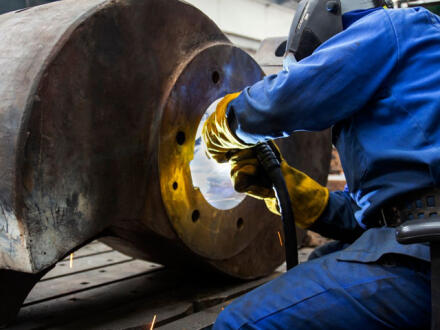
Millwright training can get expensive fast. Tuition is only part of it. Tools, boots, safety gear, gas, books, and certification fees can turn a manageable plan into a stressful bill stack.
That is why Arizona Millwright Scholarships matter. They can reduce direct school costs, lower out-of-pocket tool expenses, and make it easier for students to stay in a program long enough to finish it. For students who want a hands-on career, that funding can be the difference between starting now and waiting another semester.
Millwright work is also worth a serious look. The U.S. Bureau of Labor Statistics reports median pay of $65,330 for industrial machinery mechanics, machinery maintenance workers, and millwrights, with about 3,800 openings each year across the occupation group. That makes skilled-trades funding more than "nice to have." It is a practical investment.
This list breaks down 10 funding paths for high school students, first-year students, community college students, trade school students, and university students in Arizona. Some options are scholarship programs. Others are grants, tuition help, or employer support that can be stacked together.
The goal is simple: help students find real ways to cut training costs without guessing where to start.
1. Arizona Apprenticeship And Union-Linked Millwright Scholarships
For many future millwrights, apprenticeship funding is the best-value path. A registered apprenticeship can combine classroom instruction with paid work, so students avoid the full-price college model. In a strong setup, a student earns wages while training instead of paying every cost up front.
A practical example: if a student earns $22 per hour for 40 hours a week, that is $880 a week before taxes while skills build on the job. That income can cover gas, tools, and part of tuition while reducing the need for private loans.
Students in Arizona should look for:
- Union-connected apprenticeship committees
- Industrial maintenance training partnerships
- Employer-sponsored millwright tracks
- Construction and plant-maintenance locals with training funds
Some apprenticeship-related awards are not labeled "millwright scholarship." They may appear as training grants, sponsor reimbursements, tool stipends, or tuition assistance.
A smart search also includes adjacent trades. For example, industrial students comparing related skilled-trade funding may find options through the steel intern award or similar maintenance-focused programs.
Where To Verify Active Application Cycles In Arizona
Students should verify active cycles directly with the training provider. Deadlines can shift by cohort, hiring demand, or available training seats.
Useful places to confirm details include:
- Local union training offices
- Registered apprenticeship sponsors listed by state or federal apprenticeship directories
- Career and technical education offices at community colleges
- Financial aid pages at schools such as Yavapai College, where technical-program information is posted for prospective students
Before applying, students should confirm 4 basics: opening date, closing date, required documents, and whether sponsorship or employer referral is needed.
2. Arizona Millwright Association Scholarships
Arizona Millwright Association Scholarships can be some of the most relevant awards because they are tied closely to the trade itself. The big advantage is fit. Reviewers already understand shop classes, mechanical aptitude, welding experience, plant maintenance goals, and apprenticeship interest.
That fit matters. A student with 120 volunteer hours, a welding certificate, and a clear industrial-maintenance plan often stands out more in a trade-specific pool than in a general academic scholarship pool with 2,000 applicants.
Students should search for associations connected to:
- Millwrights
- Industrial maintenance
n- Mechanical trades
- Construction maintenance
- Reliability and plant engineering
Association scholarships may be smaller than large statewide awards, but smaller pools can improve the odds. A $1,500 scholarship might cover books, PPE, and lab fees for one term.
Students who broaden their search to overlapping trade groups can also review the reliability scholarship listing, which connects well with maintenance and engineering interests.
What To Check In Association Eligibility, Deadlines, And Required Documents
Trade associations often ask for more than grades. They want proof that the student is serious about the field.
Students should check for these requirements:
- Minimum GPA, often 2.5 to 3.0
- Arizona residency or school attendance
- Enrollment in a trade, maintenance, welding, or industrial program
- A short essay, often 250 to 500 words
- One or two recommendation letters
- Resume, transcript, or proof of program acceptance
A strong application packet should be built early. Waiting until the last 48 hours usually leads to weak essays and missing signatures.
3. Arizona Millwright Scholarships For High School Students
Arizona Millwright Scholarships for High School Students usually reward preparation, not perfection. A student does not need a flawless transcript. He or she needs evidence of direction: shop coursework, drafting, welding, robotics, FFA, SkillsUSA, or part-time mechanical work.
A concrete example helps. A student with a 3.1 GPA, 2 semesters of welding, and 1 summer helping maintain irrigation pumps can write a far stronger trade essay than a student who only says, "I like working with my hands."
Good funding targets for high school seniors include:
- Regional trade and construction foundations
- Arizona community foundations
- Career and technical education awards
- Broad Arizona scholarships that can still be used for technical education
Students with additional barriers should also review the Arizona barriers award, since broad state scholarships can sometimes stack with trade-focused funding.
This stage is also where family income matters. A student who files aid forms early may combine a local scholarship, a school grant, and work-study. Even three awards of $1,000 each can cut a first-term bill by $3,000.
High school counselors often know about small local awards that never trend online. Those are worth asking about because a pool of 40 applicants is very different from a pool of 4,000.
4. Arizona Millwright Scholarships For First-Year Students
Arizona Millwright Scholarships for first-year students matter because the first two terms often have the highest surprise costs. Students buy hand tools, steel-toe boots, gloves, calculators, books, and lab supplies before any paycheck from the trade arrives.
That first-semester pile can reach $1,200 to $2,500 depending on the program. A scholarship that looks "small" on paper can still solve a real problem.
First-year students should focus on:
- New-student institutional scholarships
- Department awards in industrial tech or maintenance
- Foundation scholarships tied to persistence or career goals
- Trade scholarships open to recent high school graduates
A useful strategy is to write one master essay and adapt it into 3 versions: career goals, financial need, and hands-on experience. That saves time and raises application volume without lowering quality.
Students entering adjacent fields should also compare options such as the welding scholarship pool, because millwright training often overlaps with fabrication, layout, and repair skills.
Another tip: first-year applicants should keep every receipt. Some school-based awards can reimburse specific items like $180 boots, a $95 hard hat, or $420 in books after enrollment is confirmed.
5. Arizona Millwright Scholarships For Community College And Trade School Programs
Community college and trade school routes are often the most direct path into millwright-related work. They usually cost less than a four-year degree, and they focus faster on maintenance, motors, machining, welding, blueprint reading, and industrial safety.
That price gap is real. If one path costs $4,800 for a certificate term and another costs $11,000, scholarship stacking becomes much easier on the lower-cost option.
Students looking for Arizona Millwright Scholarships for College at the two-year level should search in several places:
- School foundation offices
- Program-specific faculty pages
- Skilled-trades donor funds
- Statewide community foundation databases
Arizona schools and regional training sites can also point students toward local technical programs, including resources connected to institutions like Arizona Western College.
This is a strong place to pair scholarships with employer help. A student can combine $2,000 in scholarships, a $1,500 grant, and a part-time maintenance job to shrink a $5,900 bill to $2,400 before personal savings.
Students should not ignore construction-adjacent awards either. The builders scholarship option may fit students whose programs feed into plant, facility, or construction maintenance work.
6. Arizona Millwright Scholarships For College Students In Technical Programs
Students already enrolled in technical programs often have a better shot than they think. Once they can show completed coursework, attendance, and instructor feedback, their applications become more specific and more convincing.
A second-year student who has passed 12 credit hours in industrial maintenance, earned a B average, and completed 80 lab hours can point to real progress. That is stronger than a generic interest statement.
Best-fit categories include:
- Industrial maintenance scholarships
- Mechanical technology awards
- Electrical-mechanical hybrid program scholarships
- Foundation awards for continuing students
This is also the stage where faculty recommendations can carry weight. An instructor who says a student finished a pump-alignment project 2 hours early with zero safety violations gives reviewers a vivid picture.
Students should ask each department one direct question: "Which scholarships go unclaimed?" Every year, some awards receive only 5 to 15 applications because students never hear about them.
For broader search coverage, students can compare trade listings on large scholarship hubs such as this scholarship directory, then narrow results to mechanical, industrial, or apprenticeship-related filters.
When possible, students should apply for awards that cover both tuition and supply costs. A $750 book award plus a $1,250 tuition award is still $2,000 off the bill.
7. Arizona Millwright Scholarships For University Students In Engineering And Industrial Majors
Some future millwrights choose the university route first, especially if they want roles in plant engineering, industrial systems, reliability, or maintenance management. Those students should look for Arizona Millwright Scholarships for University through engineering, applied science, and industrial technology departments.
This path can make sense for students who want both field knowledge and technical leadership. A university student who studies mechanical systems and also works part-time in maintenance can build a profile for planner, supervisor, or reliability roles later.
At larger institutions such as Arizona State University, students can explore engineering-related scholarships, departmental awards, and internships tied to industrial employers.
Good search terms include:
- Mechanical engineering scholarships
- Industrial engineering scholarships
- Manufacturing systems scholarships
- Reliability or maintenance scholarships
Concrete example: a student with a 3.4 GPA, 1 CAD course, and 1 summer shutdown internship may qualify for both academic and industry-funded awards. Stacking $3,000 from a department with $2,000 from an outside trade group can make a noticeable dent in university costs.
Students near the University of Arizona should search by major, college, and donor fund instead of only by the word "millwright." Many relevant scholarships sit under industrial, mechanical, or manufacturing labels rather than trade labels.
8. Employer-Sponsored Tuition Assistance For Future Millwrights In Arizona
Employer tuition help is one of the most overlooked funding paths. A plant, contractor, mine, manufacturer, or service company may pay part of school costs if the student agrees to work, stay employed for a set period, or train in a needed skill area.
A common setup is simple: the employer reimburses 50% to 100% of tuition after the student earns a passing grade. If a class costs $900, even a 75% reimbursement cuts the employee's share to $225.
Students should ask employers these exact questions:
- Is tuition paid up front or reimbursed later?
- What grade is required: C, B, or pass/fail?
- Are books and tools covered?
- Does the employee need to stay 6 months or 12 months after reimbursement?
This path works especially well for students already in maintenance helper, fabrication, warehouse mechanic, or plant-support roles. A supervisor may know about a budget line that HR never advertises widely.
National pre-apprentice examples can also help students understand how these programs are framed, including the pre-apprentice scholarship example.
For some students, employer help beats a scholarship race. Instead of writing 12 essays, they may submit 1 reimbursement form after each term.
9. Need-Based Grants And Aid You Can Stack With Millwright Scholarships
Need-based aid is the layer that many students skip, and that costs them real money. Scholarships are useful, but grants can be even better because they often do not need to be repaid.
A simple stack might look like this:
- $2,000 local trade scholarship
- $1,500 school foundation award
- $3,000 need-based grant
- $800 work-study earnings in the first term
That adds up to $7,300. For a student in a lower-cost certificate or community college track, that can wipe out most tuition and fees.
Students should file every required aid form early and follow through on verification requests fast. Missing one tax document can delay aid by weeks.
Arizona families should also search charitable grant databases and regional education funds through organizations such as the Arizona Community Foundation, which connects donors and students across the state.
This is where Arizona Millwright Scholarships for College become more powerful. On their own, they help. Stacked with grants, they can change the full math of attendance.
If a student still has a gap, the financial aid office should be asked about emergency aid. Even a $500 completion grant can keep a student from dropping a course over a broken alternator or overdue utility bill.
10. National Skilled Trades Scholarships That Arizona Millwright Students Can Use
Not every useful award has "Arizona" in the title. National skilled-trades scholarships can work well for Arizona students if the eligibility rules allow out-of-state applicants or students enrolled in approved U.S. programs.
That matters because broader trade categories often include millwright-relevant skills such as welding, industrial maintenance, machinery repair, fabrication, safety, and construction technology.
Strong categories to search include:
- National manufacturing scholarships
- Welding and fabrication awards
- Mechanical maintenance scholarships
- Construction foundation scholarships
A realistic strategy is to apply to 10 local scholarships and 10 national trade scholarships. If a student wins only 2 awards at $1,250 each, that is still $2,500 gained from effort that can be repeated each term.
Students using scholarship platforms should filter by major, trade, residency, and award size. They should also track deadlines in one spreadsheet with 5 columns: award name, amount, deadline, documents, and submission status.
National options are especially helpful for students whose local pool is thin. And for students building an industrial profile, related sectors like steel, reliability, and welding often open more doors than a strict keyword-only search.
Arizona Millwright Scholarships FAQs
What types of scholarships are available for Arizona millwright students?
Arizona millwright students can access scholarships through apprenticeships, trade associations, community colleges, universities, employer tuition assistance, and need-based grants, all designed to reduce training costs and support completion.
How can union apprenticeships help with the cost of millwright training in Arizona?
Union-linked apprenticeships combine paid work with classroom training, allowing students to earn wages—often around $22/hour—while learning, which helps cover tuition, tools, and related expenses without upfront costs.
What qualifications do Arizona Millwright Association Scholarships typically require?
Applicants usually need at least a 2.5 to 3.0 GPA, Arizona residency or school enrollment, relevant trade program participation, an essay (250–500 words), recommendation letters, and proof of commitment to millwright or industrial maintenance careers.
Are there scholarship options for high school students interested in becoming millwrights in Arizona?
Yes, high school students with coursework or experience in welding, shop classes, or SkillsUSA can apply for regional trade scholarships, community foundation awards, and career & technical education funding, often requiring an essay and demonstration of direction.
Can university students studying engineering or industrial majors in Arizona apply for millwright-related scholarships?
Yes, students at universities like Arizona State University and the University of Arizona can find scholarships through engineering, industrial technology departments, and donor funds that support plant engineering and industrial maintenance career paths.
What is the benefit of combining scholarships with need-based grants for millwright students?
Stacking scholarships with need-based grants and work-study can significantly reduce or eliminate tuition and fee expenses, sometimes covering over $7,000 in aid, making millwright training more affordable and accessible.









