

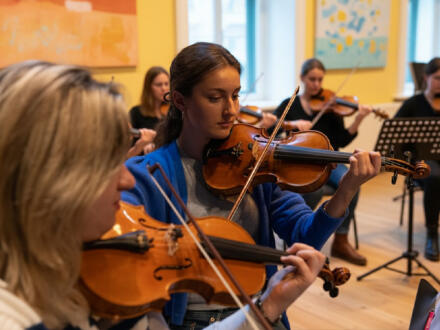
Music school can get expensive fast. Tuition, private lessons, instrument repairs, accompanist fees, audition travel, and sheet music can push the price far beyond the sticker cost of college.
That is why Colorado Music School Scholarships matter so much for students who want to study performance, composition, music education, or another music field without taking on crushing debt. A single award of $1,000 to $5,000 can cover an instrument upgrade, a semester of lessons, or a chunk of tuition. Stack a few awards together, and the math starts to look a lot better.
Students in Colorado have more options than they often realize. Some scholarships target high school seniors, some focus on first-year students, and others support students already enrolled in college music programs. There are also awards from music associations, local foundations, and universities themselves.
This list breaks down 10 practical scholarship paths students can use to build a real funding plan. It also explains how to strengthen an application, pair scholarships with need-based aid, and avoid the mistakes that sink strong candidates. For students who love music but worry about cost, this guide gives them a clear place to start.
1. Colorado Music School Scholarships For High School Students
High school students usually have the widest scholarship window because they can apply before college starts and while audition prep is fresh. This is the best stage to search for Colorado Music School Scholarships for High School Students.
A strong starting point is awards aimed at student musicians with clear artistic potential. For example, the Creative Soul music award highlights support for music education, while the GMBS music scholarship is tied to a long-standing music legacy and can fit students planning serious study.
Students should also look beyond "music" in the scholarship title. Local awards for Colorado residents can free up cash for music expenses even if they are not music-specific. The Colorado resident merit options are one example.
What makes a high school applicant competitive?
- A polished audition recording with clean audio and contrasting repertoire
- A transcript with steady grades, especially in core classes
- Documented music involvement, such as choir, marching band, jazz band, or state ensembles
- Specific goals like music education, performance, or composition
One concrete example: a student who earned first chair in regional honor band, maintained a 3.7 GPA, and taught beginner trumpet lessons for 2 hours each week has a stronger story than a student who simply writes, "music is my passion." Specifics win.
2. Colorado Music School Scholarships For First-Year Students
First-year students often miss scholarships because they assume aid ends after senior year of high school. It doesn't. In fact, Colorado Music School Scholarships for first-year students often open after admission, once a college can review an audition and academic file together.
Colorado residents should pay special attention to awards meant for incoming freshmen. The entering freshman scholarships page is relevant here because it focuses on students starting college, not students already halfway through a degree.
University scholarship offices also matter. The CU scholarship office outlines campus and partner opportunities that can combine with departmental music aid. That matters because a first-year music student may receive one talent award, one academic award, and one general resident scholarship in the same package.
Best moves for first-year applicants
- Apply after admission offers arrive, not just before
- Ask whether the music department has separate audition-based awards
- Submit FAFSA or state aid forms early
- Keep updating the résumé with senior-year honors
A practical scenario: if a first-year student gets $3,000 in academic aid, $2,500 in music talent aid, and $1,000 from a local donor award, that is $6,500 off the first-year bill. That can cover a meal plan or a big share of housing.
3. Colorado Music School Scholarships For College Students Continuing Their Music Studies
Students already in college still have strong options. This is where Colorado Music School Scholarships for College become important, especially for sophomores, juniors, and transfer students who have proven they can handle juries, ensembles, and academic work.
Continuing students should look for scholarships tied to progress in the major. A music education student with strong observation reports, or a performance major with a standout jury, can become more competitive than they were in high school. Some awards also favor students who stay active in campus ensembles, accompany peers, or contribute to community arts programs.
The Dorian De Long arts and music award is worth reviewing for students whose work spans the arts. Music pedagogy students may also find relevant support through the music pedagogy scholarship.
Why continuing students can stand out
- They have real college-level performance history
- Faculty can write sharper recommendation letters
- Their transcripts show major-specific success
- They can document measurable growth
Example: a sophomore vocalist who raised a GPA from 3.2 to 3.8, performed in 2 operas, and logged 40 volunteer hours teaching elementary singers has a compelling case. Scholarship committees like progress they can measure.
4. Colorado Music School Scholarships For University Music Programs
Departmental aid can be one of the biggest sources of funding for music majors. Students searching for Colorado Music School Scholarships for University should focus on what each university music program offers through auditions, studio placement, and departmental review.
The CU Boulder College of Music is a useful example of how university music schools position training, ensembles, and professional preparation. In many music programs, scholarship decisions depend on a mix of factors:
- Audition strength
- Studio openings for the student's instrument or voice type
- Academic profile
- Ensemble needs
That last point matters more than students think. A university may have 14 strong soprano applicants but only 3 bassoonists. If the orchestra needs a bassoon player, the aid picture can shift fast.
Students should also ask whether awards renew automatically. Some university music scholarships require:
- A minimum GPA, often 3.0
- Participation in a major ensemble each semester
- Passing juries on schedule
A realistic example: a pianist may win $4,000 in departmental talent aid but must maintain a 3.0 GPA and perform in assigned ensemble settings. Missing those terms can cost the award the next year, so the fine print matters.
5. Colorado Music School Association Scholarships To Add To Your List
Association-based awards are often overlooked, which is good news for organized students. Colorado Music School Association Scholarships and similar arts-group awards can have smaller applicant pools than giant national programs.
These scholarships may come from music teachers' groups, choral organizations, band associations, private clubs, or arts nonprofits. Some focus on future teachers. Others support performers, composers, or students who show service to their local music community.
A useful tactic is to think sideways. A student interested in music education may qualify for both a music scholarship and a teacher-training scholarship. A student involved in youth leadership or community clubs may also fit broader awards such as Colorado 4-H scholarships, depending on background and participation.
What association scholarships often look for
- Membership or participation in a related group
- Teacher recommendations from private instructors or directors
- A service record, such as section leadership or tutoring
- A focused career goal
One concrete edge: if an association gets 85 applications instead of 850, the odds improve a lot. Students who spend 45 minutes finding smaller programs can sometimes get better returns than they would from spending 4 hours on one giant national award.
6. Merit-Based Scholarships For Performance, Composition, And Music Education Majors
Merit-based awards are the backbone of many music aid packages. They reward ability, preparation, and fit. For music students, that usually means auditions, academics, faculty recommendations, and evidence that the student will contribute to the department.
Performance majors often compete on stage presence and technical control. Composition students may submit scores and recordings. Music education majors usually need both musical skill and a convincing teaching path.
Performance And Audition-Based Awards
Performance awards usually depend on an audition or recorded submission. Faculty often assess:
- Tone quality
- Intonation
- Rhythm accuracy
- Interpretation
- Difficulty of repertoire
A violinist who plays two contrasting pieces with clean phrasing and steady tempo usually beats a student who chooses flashy repertoire but struggles with intonation. Clean execution matters.
The Donald Runnicles music award is one example of a music-focused opportunity students can examine while building a merit-based list. Broader arts options, including Rossini Club awards, can also fit students with strong performance records.
A useful benchmark: many college audition recordings run 10 to 20 minutes. Students who record 3 full takes of each piece and review them with a teacher usually submit stronger material than students who record once the night before.
Academic And Departmental Music Scholarships
Not all merit money comes from the audition room. Academic and departmental scholarships can reward grades, test scores when used, leadership, and reliability inside the department.
Music schools like students who show they can handle theory, ear training, music history, and general education classes. A student with a 3.8 GPA, solid rehearsal attendance, and a faculty note that says "always prepared" may be easier to fund than a more talented but inconsistent player.
Students should search broadly across scholarship databases and campus offices. On a large scholarship list, they can sort by subject, state, and eligibility to build a smarter stack of applications.
Departmental committees often favor students who do the small things well:
- Show up early
- Submit forms on time
- Respond to email quickly
- Help ensembles run smoothly
That sounds basic, but it counts. In a close decision between two students, reliability can be the deciding factor.
7. Need-Based Financial Aid Options That Pair Well With Music Scholarships
Scholarships work best when students combine them with need-based aid. This section matters because even a strong music award may leave a large gap once tuition, housing, books, and instrument costs are added up.
The first move is simple: file the FAFSA as early as possible. According to Federal Student Aid, eligibility for grants, work-study, and some campus aid starts there. A student with financial need may be able to pair music scholarships with:
- Federal Pell Grants
- State grants
- Work-study
- Institutional need-based grants
Financial aid offices can also help students compare total cost, not just tuition. A school offering $5,000 in music aid may still cost more than a school offering $3,500 if housing is $4,200 higher.
For comparison, many university aid offices, including financial aid programs, explain how grants, scholarships, loans, and work-study fit together. The process is similar at many colleges, even if award names differ.
A realistic strategy is stacking aid in layers. Example:
- Music scholarship: $4,000
- Pell Grant: $3,200
- State or campus grant: $2,500
- Work-study: $2,000
That totals $11,700. For some in-state students, that can cut the remaining bill by half or more.
8. Local Colorado Scholarships From Community Foundations, Arts Groups, And Schools
Local scholarships are often the most underused part of a student's plan. Community foundations, booster clubs, local arts councils, rotary groups, and memorial funds may each award $500 to $2,500. Those smaller numbers add up fast.
Students should search by city, county, high school, and music area. A student in Fort Collins may qualify for something different from a student in Pueblo or Grand Junction. Guidance offices and private teachers often know about awards that do not rank well in search engines.
Colorado-specific general scholarships can also free up money for music costs. For example, the Colorado Masons fund and the Colorado Garden Foundation award are not music-only, but they can still reduce the full bill. That gives students more room to pay for reeds, strings, accompanists, or lesson fees.
Good local sources to ask about
- High school counseling offices
- Local community foundations
- Arts nonprofits and youth orchestras
- Church music programs
- Regional music teacher groups
One strong example: a student who wins three local awards worth $1,000 each gets $3,000. That can cover roughly 30 private lessons at $100 each or a semester of room charges at some lower-cost campuses.
9. How To Build A Strong Music Scholarship Application
A strong application makes the committee's job easy. It gives clear proof that the student is prepared, serious, and worth funding.
The best applications usually include five parts working together:
- A focused résumé
- A sharp personal statement
- Specific recommendation letters
- A clean audition recording or portfolio
- Proof of academic consistency
Students should avoid vague claims. "Music changed my life" is not enough on its own. A better sentence sounds like this: "They practiced clarinet 6 days a week for 45 minutes, served as section leader for 2 semesters, and organized a chamber recital that raised $1,240 for instrument repairs at the school." That is concrete. It sticks.
Recommendation letters should also contain details. The strongest letters mention things like attendance, repertoire difficulty, rehearsal habits, and leadership. A band director saying a student "improved sight-reading scores from 72 to 91 across one semester" is giving the committee real evidence.
Students can save time by using a platform that helps organize options and deadlines. On music and arts awards, they can compare fit and avoid wasting effort on programs they do not qualify for.
And yes, presentation matters. A file named FinalScholarshipEssay2reallyfinal.pdf looks sloppy. A file named Lastname_Firstname_MusicEssay.pdf looks ready.
10. Deadlines, Auditions, And Mistakes To Avoid When Applying
Most scholarship losses do not happen because a student lacks talent. They happen because the student misses a deadline, uploads the wrong file, or sends a rushed recording with bad sound.
Music scholarships often require multiple steps:
- College application
- Music application
- Prescreening recording
- Live audition or interview
- FAFSA or aid forms
That stack creates room for mistakes. A student may submit a college application on time but miss the separate school-of-music deadline by 3 days. That can wipe out thousands of dollars in possible aid.
Common mistakes
- Ignoring audition rules for repertoire, time limits, or accompaniment
- Using poor audio, like a phone recording with air conditioner noise
- Sending generic essays to every scholarship
- Missing recommendation deadlines because teachers were asked too late
- Failing to confirm renewal terms after winning an award
A simple system helps. Students should build a spreadsheet with columns for deadline, audition date, repertoire, transcript request, recommendation request, and submission confirmation. Even a list of 12 applications becomes manageable when each task has a date.
A practical rule: ask recommenders at least 21 days before the due date. For auditions, record at least 14 days early. That gives enough time to fix sound problems, wrong takes, or missing uploads without panic.
Colorado Music School Scholarships - Frequently Asked Questions
What types of Colorado Music School Scholarships are available for high school students?
High school students can apply for scholarships targeting artistic potential, such as the Creative Soul music award and the GMBS music scholarship. Local resident merit scholarships also offer funding that can be used for music expenses.
How can first-year college music students in Colorado maximize scholarship opportunities?
First-year students should apply after admission with updated résumés and FAFSA forms, seek both campus and departmental awards, and combine talent and academic scholarships for significant financial support.
What factors do universities consider when awarding music scholarships in Colorado?
Universities consider audition strength, instrument or voice studio openings, academic profile, and ensemble needs. Scholarships often require maintaining minimum GPA and participation in ensembles to renew awards.
Which association scholarships support Colorado music students, and what do they usually require?
Music teachers' groups, choral organizations, and arts nonprofits offer scholarships requiring membership, teacher recommendations, service records, and focused career goals. Examples include awards favoring future music educators or community contributors.
How can Colorado music students build strong scholarship applications?
Strong applications include a focused résumé, specific recommendation letters, clear audition recordings, a sharp personal statement, and proof of academic consistency. Avoid vague claims and submit organized, polished materials on time.
What are effective strategies to combine music scholarships with other financial aid?
Filing the FAFSA early opens eligibility for grants, work-study, and institutional aid. Combining music scholarships with Pell Grants, state grants, and work-study helps cover tuition, housing, and other costs efficiently.